

Preparing for retrenchment in Singapore means knowing how long your accessible savings can cover essential expenses and whether your insurance remains adequate after employment ends. A resilient plan should also account for serious illness and unexpected parent care costs, especially when household income is already under pressure. Stress-testing these scenarios helps you spot gaps before you need to rely on your plan.
Most financial plans assume employment continues, health remains stable and parents stay financially independent. These assumptions may hold for years, but a financial plan also needs to cope when one or more of them changes.
Stress-testing is a form of personal financial planning that looks at what happens when income stops or a major expense appears. Your financial plan can come under pressure when you run out of accessible cash, need to sell assets or give up important insurance coverage, or have to delay long-term goals such as retirement to rebuild your savings.
Many Singaporeans may appear financially secure on paper, but they cannot always readily access assets such as CPF savings and property to manage a short-term cash-flow crisis. Preparing for retrenchment in Singapore therefore starts with knowing what cash, insurance and other resources you can actually use when income stops.
Four numbers to establish for personal financial planning
Personal financial planning starts with a clear baseline. Before testing different financial shocks, calculate four numbers that show how much your household needs and what remains available during a crisis.
| What to calculate | How to calculate it | Why it matters |
| Monthly survival cost | Add mortgage or rent, utilities, insurance payments, food, transport and parental allowance. Remove discretionary spending. | This is the minimum your household needs to keep running during a crisis. |
| Cash you can access quickly | Add cash in the bank, fixed deposits, Treasury bills maturing within 90 days and Singapore Savings Bonds. You may have to wait up to about a month to receive the proceeds from redeeming your Singapore Savings Bonds. Do not count CPF savings. | This is your practical financial buffer and shows how long you can cover expenses without income. |
| How long your CPF savings can cover your home loan | Divide your CPF housing savings by your monthly mortgage instalment. | This shows how many months your mortgage can continue without salary contributions. |
| Your insurance outside work | List policies you pay for personally rather than through your employer. Record what each policy covers, its payout and the conditions for claiming. | Employer insurance usually ends when employment ends. This shows what protection stays in place regardless of your job. |
These figures give you a consistent baseline for testing retrenchment, serious illness and parent care without treating assets that are difficult to access as ready cash.
How retrenchment in Singapore affects your finances over time
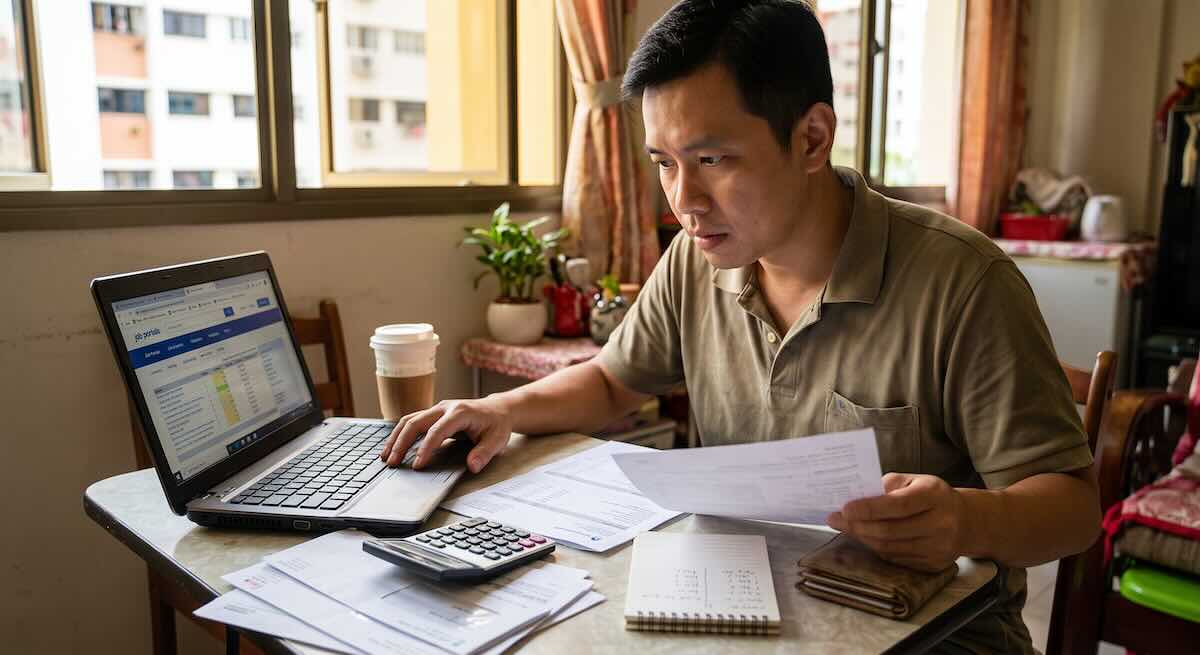
Retrenchment affects more than your monthly salary. It can expose gaps in accessible savings and insurance that are easy to overlook while you are still employed.
According to MOM, retrenchments rose from 13,020 in 2024 to about 14,400 in 2025, driven mainly by job cuts in Transportation & Storage and Financial Services. PMETs continued to face the highest retrenchment incidence of any occupational group. These figures show why it is useful to assess your financial runway before income stops.
MOM guidelines recommend retrenchment benefits in Singapore of two weeks to one month of salary per year of service for employees with at least two years of service. This is a prevailing norm rather than a legal entitlement unless it is included in your employment contract or collective agreement.
Add any retrenchment package you expect to receive to your accessible savings, then compare the total with your monthly survival cost. Your retrenchment benefits in Singapore help show how long your initial buffer may last before you need to rely more heavily on savings.
Three areas deserve particular attention when assessing your retrenchment exposure:
- Insurance linked to your employer: Company insurance usually ends on your last day. Some group policies allow conversion to an individual plan within a limited period. If your health changes while you are looking for work, obtaining new individual coverage may become harder and more expensive. A policy you hold personally is not affected by your employment status.
- Your realistic savings runway: The amount of emergency savings you need depends partly on how long it could take to find comparable work. A niche specialist may need a 12-month buffer, while a generalist in high demand may need three months.
- Available employment support: The SkillsFuture Jobseeker Support Scheme provides up to S$6,000 over six months for eligible Singaporeans who are involuntarily unemployed and actively looking for work. Include the support in your calculations if you qualify, but do not make it the foundation of your plan.
Read more: CPF, ComCare and Jobseeker Support During Unemployment
Getting seriously ill and managing the costs after hospitalisation
Serious illness tests more than your ability to pay a hospital bill. It can also reduce household income and increase ongoing expenses during recovery, making it important to consider health and income protection alongside your retrenchment buffer.
According to the LIA Singapore Protection Gap Study 2022, the critical illness protection gap among economically active Singaporeans and Permanent Residents stands at 74%. Existing coverage therefore meets only 26% of estimated needs across the population studied.
Hospital insurance typically does not cover every financial consequence of serious illness. Important costs to account for include:
- Lost income during and after treatment
- Ongoing medication, specialist follow-up and rehabilitation
- Caregiver support or home modifications
- Income lost when a spouse reduces working hours to provide care
Critical illness insurance pays a lump sum when you are diagnosed with a covered condition such as cancer, heart attack or stroke. Most plans cover the 37 severe-stage conditions defined by LIA, while some also provide payouts at earlier stages. When assessing the amount of protection you need, consider how many months of your household’s survival costs the payout would need to replace.
The same LIA study found that the average critical illness policyholder holds S$193,300 in coverage, or approximately 2.1 times annual income. The 74% protection gap applies to the whole economically active population rather than only policyholders, so it includes both people with insufficient coverage and people with none.
Without enough protection, households may need to draw on savings or put long-term financial goals on hold. A policy that provides monthly income when you cannot work can more directly bridge the income gap, although fewer people in Singapore purchase this type of coverage.
Read more: Comprehensive Guide to Disability Income Insurance
Parent care and long-term care insurance in Singapore

A parent’s loss of independence can create another major financial obligation for a household. Long-term care insurance in Singapore and government subsidies can help with these costs, but they may not cover the full cost of care.
A stroke at age 72, for example, may involve hospitalisation followed by a recovery facility and then either home care or a nursing home. The financial impact can therefore continue well beyond the initial hospital stay.
Long-term care insurance in Singapore pays a monthly amount when a person cannot perform at least three of six activities of daily living. These activities are washing, dressing, feeding, toileting, walking or moving around, and transferring, such as moving from a bed to a chair.
CareShield Life covers Singapore Citizens and Permanent Residents born in 1980 or later. New claims made in 2026 pay S$689 a month for life.
Parents born in 1979 or earlier are more likely to be covered by ElderShield, which pays a fixed S$300 or S$400 a month for five or six years. They can upgrade to CareShield Life only if they have no existing disability, so the decision needs to be made before a qualifying health event occurs. These payouts help with care expenses but may not cover them in full.
Household income can also affect how much government support a parent receives. MOH calculates long-term care subsidies based on monthly income per person in the household and counts only family members who live together. A higher-earning adult child living at the same address can therefore place a parent in a lower subsidy tier even when the parent has limited savings.
For example, one child earning $10,000 a month while living with two retired parents produces a household income of about $3,333 per person. At that level, a parent born in 1969 or earlier qualifies for a 55% subsidy on home and day care services. With no household income and a property with an annual value of $21,000 or less, the same parent could qualify for up to 95%.
Read more: Best CareShield Life Supplements in Singapore
How to stress-test the three financial scenarios
Testing each scenario against the same financial baseline makes it easier to see where your current plan may be vulnerable. The table below connects each financial shock with the risk that may be missed and the figures or coverage worth checking.
| Scenario | Risk people may miss | What to check |
| Retrenchment | Employer insurance usually ends on your last day. If your health changes during your job search, obtaining new individual coverage can become more difficult or costly. | Calculate how many months your accessible savings can cover your survival costs without income, taking into account how long someone in your field may need to find work. |
| Critical illness | Coverage may focus on the hospital bill rather than months of lost income and additional care expenses. | Multiply your monthly survival cost by 18 to 24 months as a minimum, then add treatment costs your hospital plan will not cover. |
| Parent’s stroke | Parents born before 1980 are often covered by ElderShield, which pays for only five or six years. Living with your parent can also affect the subsidies and caregiving support available to them. | Check whether your parent is covered by ElderShield or CareShield Life and how your household income affects MOH subsidies and the Home Caregiving Grant. |
These scenarios can overlap. Retrenchment can happen at the same time as illness, while parent care costs can arise when household income is already under pressure.
Read more: Financial Planning While Supporting Elderly Parents
What a financially resilient plan looks like
A financially resilient plan should be able to absorb a significant shock without forcing you to give up important protection or permanently derail long-term goals. Across the three scenarios, resilience depends on accessible cash, suitable insurance and a realistic view of potential family obligations.
A resilient plan should have three elements in place:
- Enough accessible cash to cover at least six months of survival costs without touching CPF savings or investments
- Insurance that can replace income over an extended recovery period rather than covering only the immediate bill
- A clear understanding of what supporting a parent could involve financially and an agreed approach to how those costs will be shared
Accessible cash gives you immediate flexibility, insurance transfers specific risks and family planning reduces uncertainty around future caregiving costs.
Conclusion
Stress-testing helps you see what your current plan can withstand and where more preparation may be needed.
Financial pressures can overlap. Retrenchment in Singapore may coincide with a health issue, while a parent’s care needs can emerge when household income is already under strain. Knowing your accessible savings, understanding what your insurance covers and discussing family obligations in advance can make these situations easier to manage.
Regular stress-testing is part of personal financial planning because it shows where your plan is resilient and where a financial shock could expose a gap.
Frequently asked questions
My CPF savings are substantial. Does that count as my emergency fund?
No. CPF savings cannot be freely withdrawn when your income stops, so your emergency fund needs to consist of accessible funds such as fixed deposits, Singapore Savings Bonds or savings you can reach within days.
My employer provides group insurance. Do I still need my own coverage?
Company insurance usually ends when employment ends, while a policy you hold independently remains in place regardless of your employment situation. If your health changes during a job search, obtaining new individual coverage may also become harder and more expensive.
How do I know if my critical illness coverage is enough?
Multiply your monthly survival cost by 18 to 24 months as a starting point. This accounts for lost income and ongoing care costs rather than focusing only on the hospital bill.
What are my retrenchment benefits in Singapore and how long will they last?
Retrenchment benefits in Singapore typically range from two weeks to one month of salary per year of service for employees with at least two years of service, based on MOM guidelines. Add your package to accessible savings and divide the total by your monthly survival cost to estimate your financial runway.