Guide to Financial Planning in Singapore
Guide to Financial Planning in Singapore

One of the three pillars of financial planning, managing your money keeps your income, spending and savings working together. Here’s how to build that foundation.
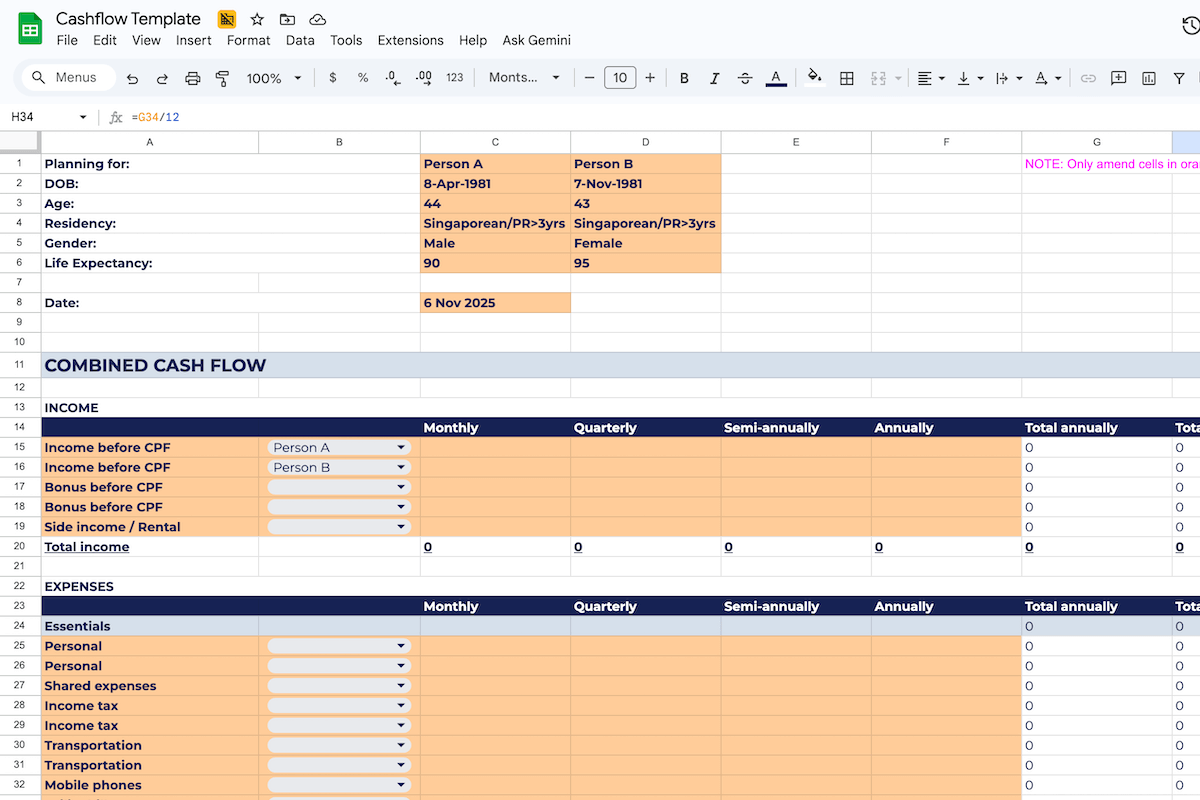
Your cash flow refers to the relationship between your income and expenses. Your income level is less easily changed in general, so financial advisors will first examine your expenses, where we can identify leaks or areas to cut back on.
Also known as liquidity ratio, this refers to liquid cash that a person should have for unforeseen situations, such as a sudden loss of income.
This money should be kept in cash or equivalent financial products that can be liquidated and accessed instantly.
Calculation: Emergency fund adequacy (a.k.a. liquidity ratio) = Cash / monthly expenses
Note: For medical emergencies, we suggest the use of insurance to mitigate these. We’ll cover this in the Protect pillar.
Recommendation: Although its impossible to be prepared for all scenarios, we recommended 6 months of your monthly expenses to be set aside for those who are employed.
For the self-employed, or for those who believe it will be harder to find a new job within a few months, that number goes up to 12 months.
This refers to the percentage of your income that you save.
Calculation: Savings ratio = Amount saved / amount earned
Recommendation: A general rule of thumb is 10% of your income. This amount could go into investments if you have already set aside an adequate emergency fund.
This measures the proportion of your take home salary that is used to service all debts. This includes housing loans, credit card loans and automobile loans.
Calculation: Debt service ratio = All debt repayment / net monthly income
Recommendation: As a general guide, debts should be less than 35% of your monthly income.
Outside of paying off a mortgage, other types of debt include credit card payment, or a car loan. These are not ideal debts in general because they tend to be related to lifestyle expenses instead of contributing to long-term investments, such as property.
Calculation: Non-mortgage debt servicing ratio = Non-mortgage debt / net monthly income
Recommendation: Spend less than 15% of your income for on these non-mortgage debt payments.
This indicates a person’s ability to repay all their existing debts with their assets. It reveals the probability of a person becoming insolvent, or bankrupt. The higher the ratio, the better your financial condition.
Solvency refers to the ability to pay one’s debt as they come due while this ratio helps to highlight the potential medium to longer-term solvency issues.
Calculation: Solvency ratio = Total net worth / total assets
Recommendation: As a general rule of thumb, your net worth should be at least 50% of your total assets.
This ratio determines how much of your assets are funded by debt.
Calculation: Debt to Asset Ratio = Total liabilities / total assets
Recommendation: You should have no more than 50% of your assets leveraged through debt. 50% or less means that there are enough assets to cover your liabilities.
Examining your financial health is a lengthier process than most people assume at first glance. But it’s worth it to ensure you reach your goals, including an easier retirement away from the anxieties of dealing with unpredictabilities.
We recommend this process be repeated every year, or if your income changes, or if situations at home change your financial commitment. These include getting a new job, having a newborn, getting married, buying property, or if a family member falls seriously ill.
Download a copy of this Google Sheet and start using it for yourself.

If you can’t remember how long it has been since you met your financial advisor,...

Have you wondered how credit scores are calculated, or what factors could affect your credit...

The internet is full of advice on personal finance. We get down to basics to...

The Singapore real estate market is remaining resilient amid the Covid-19 pandemic, powered by investment...

In the process of finding the best home loan package? We understand how some mortgage...
What are the 6 key personal finance ratios?
The six ratios are emergency fund adequacy, savings ratio, debt servicing ratio, non-mortgage debt servicing ratio, solvency ratio, and debt-to-asset ratio. Together they give a snapshot of your cash flow, debt load, and overall financial resilience.
How much should I keep in my emergency fund in Singapore?
Set aside 6 months of monthly expenses if you’re employed, and 12 months if you’re self-employed or expect a longer job search. Keep it in cash or instantly liquid instruments so it’s accessible when income suddenly stops. Medical emergencies are better covered through hospitalisation insurance than cash reserves.
What is a good savings ratio?
Aim to save at least 10% of your income. Once your emergency fund is fully built up, that 10% can be redirected into investments to grow your money over time.
What is the debt servicing ratio and what’s a healthy level?
It’s the share of your net monthly income used to repay all debts, including housing, car, and credit card loans. Keep total debt repayments below 35% of your monthly income. Note this differs from the regulatory TDSR (Total Debt Servicing Ratio) of 55% that banks apply when assessing home loan eligibility.
Why is non-mortgage debt treated separately?
Non-mortgage debt, credit cards, car loans, personal loans, usually funds lifestyle spending rather than an appreciating asset like property. Keep these repayments under 15% of your income, since they don’t build long-term wealth the way a mortgage on property can.
What does the solvency ratio tell me?
It measures whether your net worth can cover your debts, signalling your risk of insolvency over the medium to long term. As a rule of thumb, your net worth should be at least 50% of your total assets. A higher ratio means a stronger financial position.
What is the debt-to-asset ratio and why does it matter?
It shows how much of your assets are funded by debt (total liabilities ÷ total assets). Keep it at 50% or below, which means you hold enough assets to cover your liabilities and aren’t over-leveraged.
Do these benchmarks apply to everyone?
They’re general rules of thumb, not fixed rules. Your ideal targets depend on your income stability, life stage, and goals. For example, the self-employed need larger emergency buffers than salaried employees.
See plans from 20+ MAS-licensed providers side by side, without any of them paying us more to be recommended.