
- How can I find out if my doctor is under my insurer’s panel?
- Can the insurer pay the hospital directly?
- How can I get a Letter of Guarantee (LOG)?
- What is the process for getting a LOG during an emergency / at the A&E?
- What’s the difference between Pre-authorisation and a Letter of Guarantee (LOG)?
- How does Integrated Shield e-filing of claims work?
- Can I claim for GP or specialist outpatient consultations?
FAQ > Claims
- When should I submit a travel insurance claim?
- If I fall sick overseas, how do I claim?
- Can I claim at a doctor or A&E after I return to Singapore?
- My luggage is damaged, can I claim?
- My flight was cancelled. Can I make a travel insurance claim?
- My flight was delayed. Can I make a travel insurance claim?
- I missed my connecting flight. Can I make a travel insurance claim?
Q: How do claims work and how long do they take?
When you purchase through Planner Bee, our dedicated support team helps with servicing and claims.
Start by contacting us via WhatsApp or email: ask@plannerbee.co. We’ll confirm the steps, forms, and documents needed, then coordinate submission with our MAS‑licensed broker partner and the insurer.
Processing timelines vary by insurer and claim type, we’ll keep you updated throughout.
Hospitalisation / Medical Insurance Claims
Q: How can I find out if my doctor is under my insurer’s panel?
Integrated Shield Plan (IP) provider has its own approved panel of specialists. Visiting a doctor from your insurer’s panel usually gives you higher coverage limits, lower out-of-pocket costs, and faster claims processing.
You can check whether your doctor is part of your insurer’s panel using the links below:
- AIA: AIA Specialist Panel
- Great Eastern: Great Eastern Specialist Panel
Partner hospitals include Mount Alvernia, Farrer Park Hospital, Thomson Medical Centre, and Raffles Hospital. - HSBC Life: HSBC Clinic List (Select “Shield”)
- Income: Income Specialist Panel
- Prudential: PRUHealthcare Panel List
- Singlife: Singlife Medical Specialists
- Raffles Health Insurance: Raffles Shield Specialists
All public hospital doctors are considered panel doctors by default, even if they’re not listed individually.
Q: Can the insurer pay the hospital directly?
Yes, in most cases, your insurer can pay the hospital directly. This is typically done through pre-authorisation, which is most useful for planned, non-emergency hospitalisations.
Applying for pre-authorisation helps you confirm that your treatment is covered and keeps your out-of-pocket costs low. It’s best to submit the request at least two weeks before your scheduled admission.
Do note that the process may differ slightly depending on whether you’re being admitted to a private or public hospital.
For Private Hospitals
If you’re being admitted to a private hospital, you’ll need to apply for pre-authorisation before your scheduled hospitalisation or surgery. This confirms your procedure is covered and allows your insurer to pay the hospital directly except for your co-payment portion.
Steps to obtain pre-authorisation:
- Visit a doctor from your insurer’s panel of specialists.
- A GP referral is not required if you already know which specialist you need to see.
- Provide your insurer with the required information (see insurer-specific steps below).
- Once approved, the insurer will issue a Letter of Guarantee (LOG) to the hospital for direct billing.
- You may still need to pay a small deposit upon admission, depending on hospital policy.
For Public (Restructured) Hospitals
If you’re admitted to a public hospital, there’s no need for pre-authorisation. The hospital will automatically issue a Letter of Guarantee (LOG) upon admission and send your claim directly to your insurer.
Insurer-specific steps for Pre-Authorisation for Integrated Shield Plans
| Insurer | Details |
| AIA | 1. Prepare the following information:
2. Visit the AIA Pre-Authorisation Portal. The policyholder must log in and submit the pre-authorisation request for LOG. 3. Once completed, please send us a screenshot of the confirmation for record-keeping.
AIA contact: HealthShield Hotline: 1800 248 8000 |
| Great Eastern | 1. Check your doctor’s eligibility under the Great Eastern Specialist Panel.
Great Eastern contact:
|
| HSBC Life | 1. Please provide us with the following information:
HSBC Life contact:
|
| Income | 1. Visit a panel specialist under the Income Specialist Panel. Income contact: Hotline: +65 6788 1777 |
| Prudential | Pre-authorisation can be completed by your clinic or by you directly. The clinic can email the completed forms and supporting documents to pre.auth@prudential.com.sg. Alternatively, you can apply via PruAccess portal
Prudential contact: email: pre.auth@prudential.com.sg |
| Raffles Health Insurance | Pre-authorisation requests are managed directly by Raffles Health Insurance through the Raffles medical network.
Raffles Health contact:
|
| Singlife | 1. Download the Singlife Pre-Authorisation Form from Singlife’s website. 2. Have your attending panel specialist complete the medical portion. 3. Submit the completed form and documents to us at ask@plannerbee.co or Singlife directly at medicalclaims@singlife.com at least five working days before admission.
Singlife contact:
|
Q: How can I get a Letter of Guarantee (LOG)?
Most medical insurance plans provide a Letter of Guarantee (LOG) facility to help cover large hospitalisation bills. A LOG acts as your insurer’s payment guarantee to the hospital, reducing or eliminating the need for you to pay the full deposit upfront.
If you purchased your plan through Planner Bee, you can message us on WhatsApp or email ask@plannerbee.co, and we’ll assist with pre-admission LOG coordination where applicable.
For public (restructured) hospitals, a LOG is usually issued automatically upon admission.
For private hospitals, a LOG is typically issued once your pre-authorisation has been approved. Final eligibility and approved amounts depend on your plan type and insurer.
Foreigners may request pre-authorisation, but Letters of Guarantee are available only to Singapore Citizens and Permanent Residents. Foreigners will need to settle their bills first and file a claim for reimbursement later.
Q: What is the process for getting a LOG during an emergency / at the A&E?
If you are hospitalised in an emergency, you can still have a LOG arranged while you are being admitted.
1. Seek medical attention
Proceed immediately to the Accident & Emergency (A&E) department of any major hospital in Singapore. Your priority should be receiving medical treatment.
2. Inform the hospital staff
Tell the hospital’s admissions or registration counter which insurer you are covered under. The hospital’s staff are familiar with insurers’ processes and can assist with the necessary paperwork.
3. LOG request
The hospital’s administrative team will contact your insurer directly (for example, Income, AIA, or other Shield providers) to request a Letter of Guarantee (LOG) on your behalf. This helps to cover or reduce the upfront cash deposit for hospitalisation or day surgery, subject to your policy conditions.
4. LOG issuance
If approved, the insurer can usually issue the LOG to the hospital on the next working day, helping to waive or reduce the required admission deposit.
5. Sign the Medical Claims Authorisation Form (MCAF)
You will need to sign the MCAF to authorise the hospital to proceed with the LOG and to allow your insurer to process your medical claim directly.
Q: What’s the difference between Pre-authorisation and a Letter of Guarantee (LOG)?
While both help you avoid large upfront payments, they serve different purposes and apply at different stages of your hospitalisation process.
| Feature | Pre-authorisation | Letter of Guarantee (LOG) |
| When is it issued | Before hospital admission | During or after admission |
| Purpose & benefits | Confirms bill will be covered | Guarantees direct payment to the hospital, minimising upfront payment at admission |
| Who applies | You, through your doctor | Hospital or insurer |
| Use case | Planned hospitalisation | Planned or emergency admission |
| Availability | All policyholders | Singapore Citizens & PRs only |
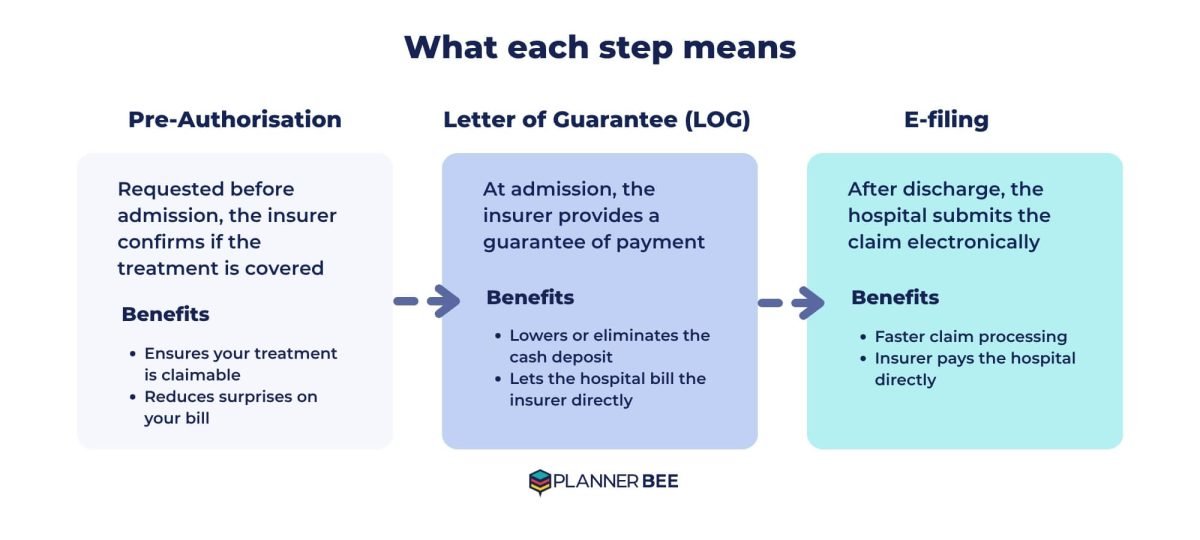
Q: How does Integrated Shield e-filing of claims work?
Please note that e-filing is only available for Singapore Citizens and Permanent Residents. If you are a foreigner or non-Permanent Resident, you’ll need to pay for your medical treatment upfront.
After your visit, simply send us the following documents:
- Medical bills, itemised
- Medical report or discharge summary
Our team will help submit the claim on your behalf and keep you informed of the progress every step of the way.
Q: Can I claim for GP or specialist outpatient consultations?
For Integrated Shield Plans: Outpatient consultations with GPs or specialists are claimable only if they are part of the approved pre- or post-hospitalisation coverage.
If there’s no associated hospitalisation or day surgery, these outpatient visits are not covered under the plan.
For Non-Integrated Shield Medical Plans: For certain plans with outpatient benefits, you may claim for GPs and specialist outpatient consultations up to your policy limits. Do refer to the exact policy wordings for more details.
Outpatient consultations with GPs or specialists are also claimable if they are part of the approved pre- or post-hospitalisation coverage.
Motor Insurance Claims
Q: What should I do after a car accident?
If you are involved in a car accident, follow these steps:
1. Check if anyone is injured
- Make sure you and your passengers are safe. If anyone is injured, call for medical assistance and the police immediately.
- If there are injuries or a fatality, avoid moving the injured person or the vehicles unless necessary for safety.
2. Take photos and videos of the accident scene
Before moving your vehicle, take clear photos of:
- The accident scene
- The position of all vehicles involved
- Damage to each vehicle
- Vehicle licence plate numbers
- Road markings, traffic signs and surrounding conditions
If there are no injuries and it is safe to do so, move the vehicles to a safe location after you have documented the scene.
3. Exchange details with the other parties
Obtain the following information from the other driver or drivers involved:
- Full name
- NRIC/FIN or other identification details
- Contact number
- Vehicle registration number
- Insurance company, if available
You should also take down the contact details of any witnesses.
4. Contact your insurer if you need assistance
Call your insurer’s accident or emergency hotline if you need advice or towing assistance.
Avoid accepting assistance from unauthorised tow-truck operators or sending your vehicle to an unauthorised workshop unless your insurer has advised you to do so.
5. Make a Traffic Police report if required
A Traffic Police report should be made as soon as possible or within 24 hours if the accident involves:
- A fatality
- Damage to government property
- A foreign-registered vehicle
- A pedestrian or cyclist
- A hit-and-run
- Someone being taken to hospital from the accident scene
- An injured person who subsequently receives at least 3 days of outpatient medical leave
A police report does not replace the requirement to report the accident to your insurer.
6. Report the accident to your insurer
Report the accident to your insurer within 24 hours or by the next working day, even if:
- There appears to be little or no damage
- You do not intend to make an insurance claim
- The other party does not intend to claim
- You have agreed on a private settlement
You can usually make the report through your insurer’s authorised Accident Reporting Centre. Check your policy documents or insurer’s website for the approved reporting locations.
Failing to report an accident may affect your claim, No-Claim Discount (NCD), or the renewal of your policy.
What if the accident happens in Malaysia or Thailand?
If you are driving overseas, first check that the location is within the geographical coverage of your Singapore motor policy. Many Singapore motor policies cover West Malaysia and parts of Thailand near the West Malaysia border, but the exact geographical limit can differ between insurers and policies.
If an accident occurs within a covered overseas area:
1. Check for injuries and contact the local emergency services if necessary.
2. Take photos and videos of the accident scene and vehicles involved.
3. Exchange particulars with the other driver or drivers.
4. Make a report at the nearest police station in the country where the accident occurred.
5. Contact your Singapore motor insurer for advice, particularly before arranging towing or repairs.
6. Report the accident to your insurer in accordance with your policy’s reporting requirements when you return to Singapore.
Keep relevant documents and evidence from the trip, including the overseas police report, photos of the accident, towing or repair documents, and proof of your travel where required.
Always check your motor policy for its exact geographical limits and overseas accident procedures.
Q: How can I contact my insurer to report a motor claim?
Below are the key contact details and reporting centre links for common insurers:
| Insurer | Hotline | Reporting Centres / Workshops |
| Eazy (any insurer) | +65 6333 2222 | — |
| AIG | +65 6338 6200 | AIG Authorised Workshops |
| Allianz | 1800 222 1818 | Allianz Motor Protect Workshop List |
| Etiqa | +65 6887 8777 | Etiqa Authorised Workshops |
| Ergo | +65 6100 1620 | Ergo Authorised Workshops |
| EQ insurance | +65 6311 3211 | EQ Reporting Centres |
| Income (Orange Force) | +65 6789 5000 | Income Reporting Centres |
| Singlife | +65 6333 2222 | Singlife Authorised Workshops |
| Tokio Marine | 1800 225 8647 | Tokio Marine Authorised Workshops |
Q: Can I use my own workshop instead of the insurer’s authorised one?
If your policy includes a “workshop plan” (i.e., coverage limited to authorised workshops), you must send your vehicle to one of the insurer’s approved repairers.
If you wish to use your own workshop, please ensure:
The workshop is able to file a claim on your behalf, and
Your insurer allows non-panel repairs under your plan.
If your chosen workshop cannot file the claim, you will need to return to an authorised workshop for assistance.
Q: How do I make a motor windscreen claim?
If your windscreen or window glass is damaged and there was no collision with another vehicle, you can file a windscreen claim.
What to know:
A windscreen excess will apply, this is usually around $100, but may vary depending on your insurer and policy. Please refer to your policy documents for the exact amount.
This claim will not affect your No-Claim Discount (NCD).
Bring along your insurance document (emailed to you upon policy issuance).
- Always confirm with the workshop that they can process the claim for your insurer before proceeding with repairs.
For eazy customers from any insurer, you may call 6576 9217 for assistance.
Q: Will a windscreen claim affect my No-Claim Discount (NCD) or renewal premium?
A windscreen-only claim typically does not affect your NCD, as it’s considered a minor claim.
However, this may vary depending on your insurer’s policy and the nature of the claim, for example, if the windscreen damage is part of a larger accident claim. If the claim includes other vehicle damages beyond the windscreen, it may be treated as a standard motor claim and could affect your NCD.
It’s best to:
Review your policy wording for NCD impact conditions
Confirm with your insurer or workshop before proceeding with the claim
Personal Accident Insurance Claims
Q: When should I submit a personal accident insurance claim?
Claims should be submitted within 30 days from the date of the accident. Prompt submission helps ensure smoother processing and reduces the risk of delays or rejection.
What happens if I submit my claim late?
Late submissions may be subject to additional review and could result in delays or denial, depending on the insurer’s policy terms. It is best to notify the insurer as soon as possible after the incident.
Q: Do I need to see a GP before visiting a specialist or physiotherapist?
Yes, a referral from a General Practitioner (GP) is required before seeing a specialist or physiotherapist for your claim to be eligible.
If you prefer to consult a Traditional Chinese Medicine (TCM) practitioner, you may do so directly without needing a GP referral.
Q: How can I check if the TCM doctor is registered?
Only treatments provided by registered TCM practitioners are covered under personal accident plans.
To confirm your practitioner’s registration, search using one of the official databases below:
Always ensure your TCM doctor appears in one of these registers before treatment. Claims for unregistered practitioners will not be eligible.
Q: What constitutes an “accident” under a personal accident plan?
An accident generally refers to a sudden, unforeseen, and external event that causes bodily injury, occurring without intent or expectation.
Examples of covered accidents include:
Slips, trips, or falls causing physical injury
Traffic or transport-related accidents
Accidental cuts, burns, or fractures
Injuries from falling objects or environmental hazards
Sports-related injuries, only if caused by an external event (e.g. a collision, fall, or impact) not from overexertion or repetitive strain
Events that are typically not considered accidents include:
Gradual wear and tear or repetitive strain injuries
Illnesses, infections, or degenerative conditions
Injuries arising from intentional acts or gross negligence
Note: Each insurer may define “accident” slightly differently in their policy terms. Always refer to your plan’s policy wording for the exact definition and exclusions.
Pet Insurance Claim
Below are the documents and details required for different types of pet insurance claims. Once you’ve gathered all the necessary documents, you can submit them to us along with the relevant claim form. all forms are available in the Claim Forms Section
Q: What is needed for an Illness or accidental injury claim for my pet?
Please prepare the following:
- Proof of ownership of the insured pet
- Original veterinary bills and/or reports
If due to an accident:
- A memo from the attending veterinarian stating the nature and suspected cause of injury
- Photos of the injury (if available)
If due to illness:
- A memo from the attending veterinarian stating the nature of illness, treatment, and prognosis
Q: What do I need to submit for a third-party liability claim?
Please prepare the following:
- Proof of ownership of the insured pet
- Original medical bills and/or medical reports
- A memo from the attending veterinarian stating the nature and suspected cause of the injury
Q: What should I provide for an accidental death claim for my pet?
Please prepare the following:
- Proof of ownership of the insured pet
- A veterinarian’s report stating the cause and time of death
Q: What documents are required for a pet theft claim?
Please prepare the following:
- Proof of ownership of the insured pet
- AVA/SPCA Lost & Stolen reference number
- A copy of the police report lodged in Singapore
Travel Insurance Claim
Q: When should I submit a travel insurance claim?
Travel insurance claims should be submitted within 30 days from the date of the insured event, such as medical treatment, trip disruption, or loss of belongings.
What if the claim is not submitted within 30 days?
Claims submitted after the 30-day period may face delays or may not be accepted, depending on the insurer’s policy conditions. Early submission is recommended to facilitate faster assessment.
Q: If I fall sick overseas, how do I claim?
You can claim medical expenses incurred abroad. Treatment must be by a registered doctor. Keep original receipts and ask the clinic to indicate the diagnosis on the receipt or memo. Retain your boarding passes (to & from Singapore) as insurers typically require them for claims.
Q: Can I claim at a doctor or A&E after I return to Singapore?
Yes. If you didn’t see a doctor overseas, seek treatment within 72 hours of arrival in Singapore. If you did see a doctor overseas, you may do follow‑up consultations, treatment, tests within 30 days from arrival.
Time limits vary by insurer, check your policy wording.
Q: My luggage is damaged, can I claim?
First, report it to the airline and file for compensation. If the airline rejects your claim, submit your travel insurance claim with the rejection letter. If the airline pays out, you generally cannot claim the same loss under your travel policy.
Q: My flight was cancelled. Can I make a travel insurance claim?
It depends on why the flight was cancelled and whether you can still continue your trip.
When it may be covered
You may be able to claim if the cancellation was caused by a covered event, such as severe weather, an airport or airspace closure, a natural disaster, or another reason listed in your policy.
If you must cancel your entire trip, the policy may cover prepaid transport, accommodation and other travel costs that cannot be refunded or reused.
Real-life example
Your flight is cancelled because the airport closes due to a typhoon, and no suitable replacement is available. You cancel the trip and your hotel refuses a refund. The non-refundable costs may be claimable.
A cancellation caused by the airline’s staffing, scheduling or operational issues may be treated as a travel delay instead, or may not be covered.
What should I do?
Ask the airline, hotel and travel agent for a refund, credit or replacement booking first. Keep their replies, your original itinerary, receipts and the airline’s written cancellation notice.
Q: My flight was delayed. Can I make a travel insurance claim?
Most policies require a minimum continuous delay, commonly six hours, before a benefit is payable. The qualifying period and payout depend on your plan.
How is the delay calculated?
Depending on the policy, it may be measured using:
- The scheduled and actual departure times;
- The scheduled and actual arrival times; or
- Your arrival time at the final destination when connecting flights are involved.
Most policies provide a flat benefit for delays before leaving Singapore and a benefit for each completed delay period while overseas.
Real-life example
Your flight is scheduled to depart at 10am but the replacement flight leaves at 5pm. This is a seven-hour delay and may qualify for one completed six-hour delay period.
Delays known before you bought the policy, checking in late, or failing to follow the airline’s revised schedule are generally not covered.
What documents will I need?
Obtain written confirmation from the airline showing the reason for the delay and the relevant departure or arrival times. Keep your itinerary and boarding passes.
Q: I missed my connecting flight. Can I make a travel insurance claim?
You may be able to claim if your incoming scheduled flight arrives late and causes you to miss a confirmed onward connection.
A minimum waiting period commonly applies. If the airline provides another connection within that period, the claim may not qualify.
Real-life example
Your first flight arrives after your connecting flight has departed, and the next available flight is eight hours later. This may qualify for a missed-connection benefit.
If you miss the connection because you arrived late at the gate, allowed insufficient transfer time, or did not follow the airline’s instructions, it is generally not covered.
What should I do?
Ask the airline for written confirmation of:
- The reason your incoming flight was late;
- Its actual arrival time;
- The missed connection; and
- The replacement flight’s departure time.
For the same disruption, you will generally be paid under either the travel-delay or missed-connection benefit, rather than both. Exact conditions, waiting periods and limits vary by policy.
Claim forms and online submission portals
Personal accident
Still need help?
If your question isn’t covered here, reach us anytime:
- WhatsApp: https://wa.me/6590117361/
- Email: ask@plannerbee.co