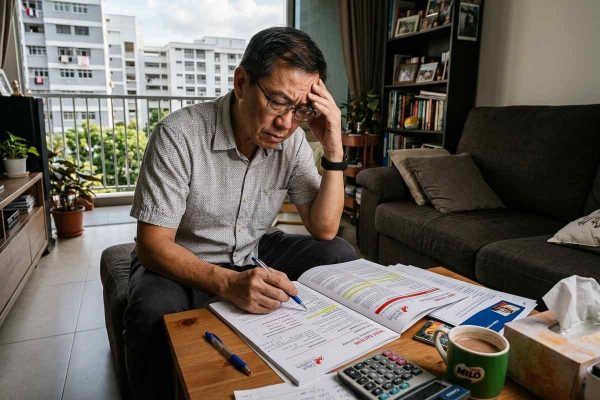

The CPF Special Account (SA) closed for members aged 55 and above on 19 January 2025, with savings moved to the Retirement Account (RA) up to the applicable Full Retirement Sum (FRS) and any excess transferred to the Ordinary Account (OA). This means some former SA savings may now earn the lower OA interest rate, so members should review their housing needs, liquidity and retirement goals before deciding whether to keep, transfer or invest those funds.
CPF permanently closed the Special Account (SA) for members aged 55 and above on 19 January 2025. The CPF SA closure moved SA savings into the Retirement Account (RA) and Ordinary Account (OA), depending on each member’s balance relative to the applicable Full Retirement Sum (FRS).
The difference in interest rates is one of the biggest practical effects. According to the CPF Board, from 1 July to 30 September 2026, the OA earns 2.5% per annum while the RA earns 4% per annum. Members whose excess SA savings moved to the OA therefore earn a lower rate on that portion of their savings.
The CPF Special Account closure in Singapore changed where members hold their retirement savings and how easily they can access them. This article explains how the redistribution worked, who was most affected, how the retirement sums apply, and what members can consider for savings now held in the OA.
What the CPF SA Closure did to your CPF savings
The closure changed how retirement savings are held for members aged 55 and above. It also explains why some members saw a meaningful amount of former SA savings move to the lower-rate OA.
According to the CPF Board, the CPF Special Account closure in Singapore affected approximately 1.4 million CPF members aged 55 and above. The closure took effect on 19 January 2025.
When a member turns 55, CPF creates a Retirement Account. SA savings move to the RA first, up to the applicable FRS. Any SA savings above the FRS move to the OA. If the SA is not enough to meet the FRS, eligible OA savings are used to make up the shortfall.
CPF SA closure example and how savings are redistributed
The following example shows how the redistribution works for a CPF member aged 55 in 2026. The member has these balances:
- S$250,000 in the SA
- S$100,000 in the OA
- An applicable FRS of S$220,400, based on the 2026 figure from the CPF Board
The SA provides the S$220,400 needed for the RA. The remaining S$29,600 from the SA moves to the OA.
| CPF account | Before SA closure | After SA closure |
| Special Account or SA | S$250,000 | S$0 |
| Retirement Account or RA | S$0 | S$220,400 |
| Ordinary Account or OA | S$100,000 | S$129,600 |
The S$29,600 transferred from the SA to the OA earns the OA rate of 2.5% per annum instead of the higher RA rate of 4% per annum. For this member, that interest rate difference is the main financial effect of the Special Account closure.
Why the CPF Special Account was closed

The Special Account closure aligned the interest rate earned on CPF savings with how accessible those savings are. Savings committed to long-term retirement remain in the RA and earn the long-term rate. Savings that are more accessible sit in the OA and earn the OA rate.
The change restructured how CPF savings are held. It did not reduce the total amount a member had within CPF.
How the CPF SA closure affects your interest rate
How much the closure affects you depends largely on how much of your former SA savings moved to the OA. The difference between the OA rate of 2.5% per annum and the RA rate of 4% per annum can add up over time, especially on larger balances.
According to the CPF Board, these rates apply from 1 July to 30 September 2026:
- OA at 2.5% per annum
- RA at 4% per annum
- MediSave Account at 4% per annum
CPF Board reviews interest rates quarterly. These rates apply only from 1 July to 30 September 2026.
The figures below show the annual interest difference across three balance levels using the CPF Board rates for this period. They are simple annual illustrations based on fixed rates. CPF calculates and credits interest using its own prescribed methodology.
| Balance | At 4% in RA | At 2.5% in OA | Difference per year |
| S$50,000 | S$2,000 | S$1,250 | S$750 |
| S$100,000 | S$4,000 | S$2,500 | S$1,500 |
| S$200,000 | S$8,000 | S$5,000 | S$3,000 |
CPF Board also pays extra interest on top of these base rates. For members aged 55 and above, the Government pays an extra 2% per annum on the first S$30,000 of combined CPF balances and an extra 1% per annum on the next S$30,000. The amount counted from the OA is capped at S$20,000. Extra interest earned on OA savings is credited to the RA.
The table above reflects base rates only and does not include this extra interest.
Read more: How CPF Interest Rates Can Help Grow Your Money
CPF Special Account closure retirement savings and the BRS, FRS and ERS
The Basic Retirement Sum, Full Retirement Sum and Enhanced Retirement Sum determine how much members set aside for retirement and how much they can transfer to the Retirement Account (RA). The CPF Special Account closure retirement savings rules depend on these thresholds because the applicable Full Retirement Sum determines how much SA savings CPF transfers to the RA and how much moves to the Ordinary Account (OA).
According to the CPF Board, the following retirement sums apply to members turning 55 in 2026:
- Basic Retirement Sum, or BRS, of S$110,200
- Full Retirement Sum, or FRS, of S$220,400
- Enhanced Retirement Sum, or ERS, of S$440,800
The FRS is twice the BRS. The ERS is twice the FRS, or four times the BRS. According to the CPF Board, Singapore raised the ERS from three times the BRS to four times the BRS in 2025. This change formed part of the same set of CPF policy reforms that included the closure of the SA.
How the BRS, FRS and ERS differ
The three CPF retirement sums serve different purposes in determining how much members set aside for retirement:
- The BRS is the minimum amount for basic retirement income and typically applies where a member has a property pledge or charge.
- The FRS is the standard retirement sum for members without a property pledge.
- The ERS is the upper limit for voluntary RA top-ups for members aged 55 and above.
CPF Board sets retirement sums annually. The sum that applies to a member is fixed in the year they turn 55. Members who reached age 55 in different years can therefore have different FRS thresholds, which affects how much of their SA savings moved to the RA and how much went to the OA.
According to the CPF Board, the FRS for members who turned 55 in 2025 was S$213,000. For those turning 55 in 2026, it is S$220,400. The year a member turns 55 therefore determines how CPF allocates their SA savings between the RA and OA.
CPF SA shielding after the Special Account closure
SA shielding was a strategy that depended on the SA continuing to exist after age 55. Once the Special Account closed, the mechanism behind the strategy disappeared, so SA shielding is no longer available to members aged 55 and above.
The strategy involved temporarily placing SA savings into eligible CPF investments immediately before turning 55. This reduced the SA balance available for transfer to the RA and allowed some savings to remain in the SA afterwards, where they could continue earning the higher long-term interest rate.
Closing the SA removed that possibility because there is no longer an SA for those savings to return to.
CPFIS-SA investments at the point of closure
CPF treated existing CPFIS-SA investments differently from cash savings held in the SA. It did not automatically liquidate these investments when the SA closed. According to the CPF Board, members may continue to hold them.
When these investments are sold or reach maturity, the proceeds move to the RA first, up to the applicable FRS. Any remaining amount goes to the OA. CPFIS-SA investment proceeds therefore follow the same RA and OA redistribution principles used during the SA closure.
CPF Special Account closure financial planning for OA savings

CPF Special Account closure financial planning involves balancing return, liquidity, and risk for savings that moved to the OA. The right choice depends on each member’s circumstances, not just the difference between the OA and RA interest rates.
The impact is greatest for members whose SA balance exceeded the FRS because the surplus now earns 2.5% rather than 4% per annum. Members whose SA fell short of the FRS had eligible OA savings drawn down to fund the RA instead.
Housing needs also matter. Someone with an outstanding housing loan may prefer to keep OA savings accessible. A member with enough liquid assets elsewhere may be more comfortable transferring eligible OA savings to the RA to receive the higher rate.
The six approaches covered here offer different combinations of liquidity, return and risk:
| Option | Liquidity | Return | Key feature |
| Keep in OA | High | 2.5% p.a. An extra 2% on the first S$30,000 combined, capped at S$20,000 from OA, is credited to the RA | Accessible for housing and eligible uses |
| Transfer to RA | Very low | Minimum 4% p.a. | Generally irreversible and supports higher CPF LIFE payouts |
| Singapore Savings Bonds | Moderate | Variable, with step-up returns over the holding period | Outside CPF and redeemable without capital loss |
| T-bills | Low | Variable and fixed at issuance | Outside CPF and not redeemable before maturity |
| Retirement or endowment plan | Low due to lock-in | Varies, with guaranteed and non-guaranteed elements | Long lock-in, with guaranteed and projected returns differing |
| CPFIS-OA | Moderate | Variable and not guaranteed | Market risk means returns can be negative |
Option 1: Retain the savings in the OA
Keeping displaced savings in the OA preserves accessibility while earning 2.5% per annum. Members can use the remaining balance for housing loan repayments, voluntary RA transfers, CPFIS-OA investments, or cash withdrawals once they meet the relevant retirement sum.
The trade-off is the 1.5 percentage point lower rate compared with the RA. Members who have already met their retirement sum may also be eligible to withdraw remaining OA savings as cash.
Read more: Should I Use CPF to Pay My Mortgage?
Option 2: Transfer OA savings to the RA
Members aged 55 and above may transfer eligible OA savings to the RA up to the prevailing ERS, which is S$440,800 for 2026. Doing so allows those savings to receive the RA interest rate instead of the OA rate, subject to CPF rules.
The transfer is generally irreversible. Anyone with an outstanding housing loan, upcoming property expenses, or limited liquid savings outside CPF should consider how much accessible cash they may need before making a large transfer.
Moving eligible savings to the RA can restore the 4% per annum floor and generally support a higher CPF LIFE payout. Members who have already started CPF LIFE payouts are subject to different top-up rules.
Read more: Can You Retire on CPF LIFE Payouts Alone?
Option 3: Singapore Savings Bonds and T-bills
Singapore Savings Bonds, or SSBs, and Treasury bills, or T-bills, are Singapore Government Securities held outside CPF. Using withdrawn OA savings for these instruments requires a permanent CPF withdrawal.
SSBs offer step-up rates for up to 10 years, and investors can redeem them in any month without losing capital, subject to the individual holding cap. T-bills pay a single fixed return over 6 months or 1 year, and investors must hold them until maturity. The issuers publish the rates for both products before purchase.
Monetary Authority of Singapore publishes issuance details and auction information for Singapore Savings Bonds and T-bills.
Read more: What To Do When Your T-bill Matures in Singapore?
Option 4: Retirement or endowment insurance plans
Licensed insurers offer retirement and endowment insurance plans outside the CPF framework. They typically combine guaranteed benefits with non-guaranteed projected returns and may provide either a lump sum or a regular income stream.
Members considering these products should assess the following features:
- Guaranteed and non-guaranteed figures are separate. The illustrated return incorporates assumptions that may not be met.
- Policy duration and the date when payouts begin.
- Premium payment obligations and the consequences of stopping premiums early.
- Surrender value at different durations. Early surrender typically produces a loss.
- Fees and charges embedded within the product structure.
- Liquidity provisions. Most plans provide limited or no early access to funds.
Comparing these plans with CPF interest rates requires more than looking at headline returns. Liquidity, lock-in period, and risk also differ. Guaranteed benefits and non-guaranteed projected returns reflect different outcomes, so investors should not treat them as equivalent.
Option 5: CPFIS-OA investments
The CPF Investment Scheme, Ordinary Account, or CPFIS-OA, allows members to invest OA savings exceeding S$20,000 in approved instruments. These include unit trusts, exchange-traded funds and corporate bonds, subject to eligibility requirements and investment caps.
How CPFIS-OA differs from CPF interest
CPFIS-OA investments carry market risk and are not guaranteed. Returns depend on the performance of the underlying investment and the fees charged. Values can fall as well as rise.
The relevant benchmark for CPFIS-OA
The OA interest rate is a useful benchmark because it is the guaranteed return a member gives up when investing through CPFIS-OA. According to the CPF Board, that rate is 2.5% per annum for the period from 1 July to 30 September 2026.
If an investment earns less than 2.5% per annum net of fees over the holding period, the member would have been better off leaving those savings in the OA.
Read more: What the New CPF Investment Scheme in 2028 Means for Your Retirement
Common CPF Special Account closure financial planning mistakes

Decisions after the Special Account closure should reflect retirement needs, housing commitments, liquidity, and risk tolerance. Several common misconceptions can push members towards choices that do not match those needs.
Mistake 1: Assuming SA savings disappeared
SA savings were not removed from the CPF system. They moved to the RA and OA based on each member’s balances and applicable retirement sum. The total amount held within CPF remained unchanged.
Mistake 2: Taking higher investment risk solely because the OA rate is lower
A lower guaranteed interest rate does not automatically make a higher-risk investment a better choice. Higher expected returns usually come with greater risk, more volatility, or less liquidity.
Members who may need the money within a short period could end up realising a loss when they need to withdraw.
Mistake 3: Transferring OA savings to the RA without assessing liquidity
OA-to-RA transfers are generally irreversible. Members with an outstanding housing loan, anticipated property expenses, or limited cash outside CPF should make sure they have enough near-term liquidity before transferring a large amount.
The higher RA rate should be weighed against the reduced access to those savings.
Mistake 4: Treating SA shielding as an available strategy
The Special Account closure removed the SA that shielding depended on. SA shielding is therefore no longer available to members aged 55 and above. Planning now takes place within the OA and RA structure.
Mistake 5: Misapplying CPF tax relief rules
Cash top-ups to the RA may qualify for tax relief under the CPF Cash Top-up Relief. According to IRAS, for Year of Assessment 2026, eligible cash top-ups may provide up to S$8,000 in tax relief for a member’s own account and up to S$8,000 for qualifying top-ups to eligible family members.
The overall personal income tax relief cap is S$80,000 per year.
From YA 2026, cash top-ups that attract matching grants under the Matched Retirement Savings Scheme, or MRSS, are not eligible for CPF Cash Top-up Relief. Full eligibility conditions are published by IRAS.
OA-to-RA transfers do not qualify for CPF Cash Top-up Relief. Their tax treatment is different from that of a qualifying cash top-up.
Read more: A Comprehensive Guide to the Matched Retirement Savings Scheme
Mistake 6: Treating current CPF rules as permanent
CPF interest rates, retirement sums, contribution rules and tax treatment can change. Planning around the CPF Special Account closure should therefore use the rules that apply at the time.
According to the CPF Board, the 2026 ERS increased to S$440,800 from S$426,000 in 2025. The government introduced this change as part of the same reform cycle as the SA closure.
Members should check updates from the CPF Board and IRAS, so their planning continues to reflect current rules.
Conclusion
The CPF SA Closure changed where CPF holds retirement savings for members aged 55 and above. SA savings moved to the RA up to the applicable FRS, with any excess going to the OA.
For members with a sizeable amount now sitting in the OA, the main decision is how to balance access to those savings against the higher interest available in the RA. Housing needs, liquidity outside CPF, and retirement goals all affect that choice.
The CPF Special Account closure in Singapore makes it more important to understand how the OA and RA work together. Their interest rates, withdrawal rules, and top-up limits can shape both retirement income and how much flexibility a member retains before retirement.
Frequently asked questions
Why was the CPF Special Account closed?
According to CPF Board, the SA was closed for members aged 55 and above to align the interest rate earned with the accessibility of the savings. Savings committed to long-term retirement remain in the RA and earn the long-term rate. Savings accessible for withdrawal sit in the OA and earn the OA rate.
What happened to my SA savings after the closure?
According to the CPF Board, SA savings were transferred to the RA up to the applicable FRS. Any surplus was moved to the OA. Where the SA was insufficient to meet the FRS, eligible OA savings covered the shortfall.
What happened to my CPFIS-SA investments when the SA closed?
CPFIS-SA investments were not automatically liquidated. According to the CPF Board, members may continue to hold existing CPFIS-SA investments. When sold or matured, proceeds transfer to the RA first (up to the applicable FRS), with any remaining amount going to the OA.
Do I still earn 4% interest on my CPF savings after the SA closure?
The rate earned depends on which account holds the savings. RA savings earn the RA rate, which carries a floor of 4% per annum. OA savings, including former SA savings now held in the OA, earn the OA rate. According to the CPF Board, from 1 July to 30 September 2026, the RA rate is 4% per annum, and the OA rate is 2.5% per annum.
Can I transfer my OA savings to my RA after the SA closure?
Yes, subject to CPF rules. According to the CPF Board, members aged 55 and above may transfer eligible OA savings to the RA up to the prevailing ERS. For 2026, the ERS is S$440,800. The transfer is generally irreversible.