
Financial planning for families supporting adults with special needs in Singapore requires clarity, patience, and long-term thinking.
Parents and caregivers often worry about daily care costs, healthcare expenses, income stability, and what happens when they are no longer around. Unlike typical financial planning, special needs financial planning must account for lifelong dependency, unpredictable medical needs, and limited earning capacity.
In Singapore, families benefit from strong government support systems, but these alone may not fully cover the long-term needs of adults with special needs.
This makes it essential to understand insurance coverage, estate planning tools, and suitable investment strategies. With the right financial plan in place, families can provide stability, dignity, and independence for their loved ones with special needs.
Understanding the categories of special needs persons

Special needs persons include individuals with physical, intellectual, developmental, sensory, or mental health disabilities. These categories help agencies and families determine eligibility for support, care services, and financial assistance.
| Category | Examples | Key considerations |
| Physical disabilities | Cerebral palsy, spinal cord injuries, muscular disorders | May limit mobility, may need assistive devices or home modifications |
| Intellectual disabilities | Down syndrome | Affects cognitive functioning and adaptive skills, may require lifelong support |
| Developmental disabilities | Autism spectrum disorder | Impacts communication, behaviour, and social interaction |
| Sensory disabilities | Hearing or visual impairments | May require specialised therapy, devices, or education support |
| Mental health conditions | Schizophrenia, severe depression | May affect employment and independent living, requires ongoing care |
Prevalence and demographics in Singapore
Disability affects individuals across all life stages:
- Students: 2.1% live with some form of disability
- Residents aged 18–49 years: 3.4%
- Residents aged 50 years and above: 13.3%
As Singapore’s population ages, the number of adults with disabilities is projected to rise significantly by 2030, increasing the financial burden on families.
Growing awareness of autism
Improved awareness and early detection have increased the number of diagnosed cases of autism. In 2014, about 1 in 150 children were estimated to have autism, with 4,400 children diagnosed with developmental issues, a 76% increase from 2010.
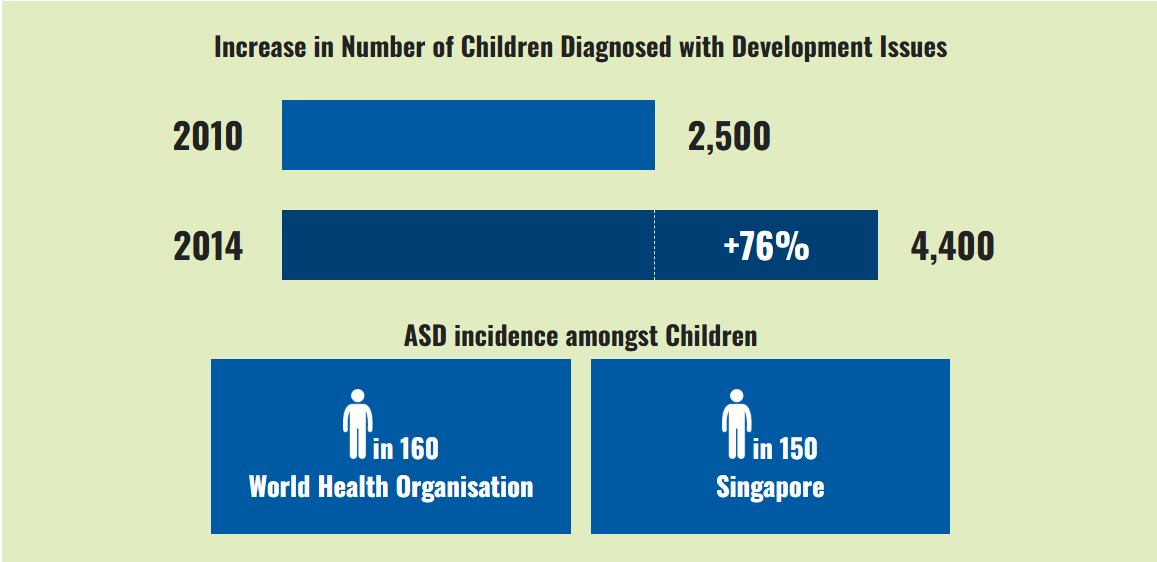
Source: SG Enable
Insurance schemes for adults with special needs
Insurance planning forms the foundation of financial planning for families supporting adults with special needs. Insurability often depends on the severity and nature of the disability, making government schemes especially important.
Government insurance schemes
MediShield Life provides basic healthcare coverage for all Singapore Citizens and Permanent Residents, including those with pre-existing conditions. It offers lifelong protection against large hospital bills and selected outpatient treatments, making it a critical pillar of special needs financial planning.
CareShield Life applies from age 30 onwards and provides monthly cash payouts if the insured becomes severely disabled and cannot perform at least three out of six Activities of Daily Living. Payouts continue for life and help families manage long-term caregiving costs.
These schemes provide essential coverage, but they may not fully meet all medical and care-related expenses. Families should plan additional financial buffers.
Read more: What’s Changing for MediSave, MediShield Life, Dental and Long-Term Care
Private insurance limitations
Private insurance options remain limited for many adults with special needs.
Insurers may exclude pre-existing conditions or decline applications for individuals with severe health issues. People with physical disabilities may not qualify for disability income insurance, while those with intellectual or developmental disabilities may face challenges obtaining health or life insurance.
Families should view private insurance as supplementary rather than core protection.
Schemes, grants and support services for adults with special needs

SG Enable and its partners administer various schemes, grants, and support services that provide baseline care and support for adults with special needs. These programmes complement personal financial planning and help manage long-term care costs.
- Adult Disability Homes provide long-term and short-term residential care for adults with disabilities who cannot receive adequate care at home.
- Adult Disability Hostels offer accommodation and residential-based training for individuals who do not require institutional care but cannot live with family. Both services will fall under the Social Residential Homes Act from 2026 to ensure quality standards.
- Day Activity Centres provide daytime care and skills training for adults aged 18 and above, supporting daily living skills and community participation while offering respite for caregivers.
- The Enabled Living Programme and Home Support Programme support adults with low to moderate support needs to live independently in the community. The Home Support Programme pilot is expected to begin in the second half of 2026.
- Enabling Services Hubs bring disability and caregiver support services closer to homes through regional community hubs.
- The Enabling Skills for Life Programme equips persons with disabilities with functional, social, and vocational skills through a person-centred approach that involves caregivers.
- Sheltered Workshops provide vocational training and supported employment for adults with disabilities who are not ready for open employment, helping them build work skills and improve employability.
Families should view these schemes as foundational support and integrate them into a broader special needs financial planning strategy.
Long-term and estate planning

Long-term and estate planning ensures continuity of care and financial security for adults with special needs after caregivers pass on. Early planning reduces uncertainty and protects the individual’s interests.
Parents can set up trust funds to safeguard assets for their children. Trusts allow appointed trustees to manage funds responsibly for healthcare, daily living, and long-term care needs. In Singapore, the Special Needs Trust Company offers trust services tailored to families supporting adults with special needs.
For individuals who lack mental capacity, families may apply for guardianship under the Mental Capacity Act. Guardianship provides legal authority to manage personal welfare and financial matters, although families should use it only when necessary.
Families can also top up Central Provident Fund accounts to strengthen long-term financial security. CPF savings provide stable returns and support healthcare and retirement needs.
Read more: How To Make a Nomination for Your Life Insurance in Singapore
Investing for their future
Investment planning for adults with special needs should focus on stability and predictable income. Families should avoid high-risk strategies that expose funds to volatility.
Annuity plans provide guaranteed income streams that support ongoing living and care expenses. Parents or siblings can also purchase life insurance policies on themselves to create a future income source or financial buffer for the adult with special needs.
Planning with confidence
Financial planning for families supporting adults with special needs in Singapore requires an integrated approach. Government schemes, insurance coverage, estate planning, and conservative investment strategies must work together. Public support provides a strong foundation, but personal planning remains essential.
When families plan early and review regularly, they create long-term stability and peace of mind. A structured financial plan helps adults with special needs live with dignity, security, and confidence throughout their lives.
Read more: All You Need To Know About the CPF’s Special Needs Savings Scheme