
Freelancing in Singapore gives workers control over their schedule, clients, and income. Retirement planning for freelancers means setting aside income, CPF top ups, SRS contributions, and investments to replace future income without employer CPF support.
Unlike salaried employees, freelancers do not receive mandatory employer CPF contributions. The employer contribution, which can add up to 17% of an employee’s monthly wage to CPF savings, does not apply to self-employed persons. This makes retirement planning more dependent on personal discipline, income management, and long-term investing.
Freelancers also face irregular income. Strong months can be followed by slower periods, which makes consistent saving harder. The earlier freelancers start planning for retirement in Singapore, the more time they have to benefit from compounding, voluntary CPF contributions, and structured investment habits.
This guide explains how to save for retirement as a freelancer in Singapore, using a worked example to show how freelancers can calculate a realistic monthly savings target.
Key takeaways
- Freelancers in Singapore do not receive employer CPF contributions, so they must self-fund retirement savings.
- There is no single correct monthly savings amount. Your target depends on income, lifestyle, housing, family responsibilities, CPF savings, and retirement age.
- A practical starting point is to calculate your annual cost of living, build a 6–12 month emergency fund, and direct excess income towards retirement.
- CPF MediSave contributions are compulsory for self-employed persons when net trade income exceeds S$6,000 a year.
- CPF retirement savings through the Ordinary Account, Special Account, or Retirement Account remain voluntary for self-employed persons.
- A retirement calculator can turn your income, CPF balances, and retirement goals into a clearer monthly savings target.
Why retirement planning in Singapore is different for freelancers
Retirement planning is different for freelancers in Singapore because self-employed persons do not have employer CPF contributions, fixed monthly salaries, or automatic retirement savings structures. This creates a wider gap between earning income today and building retirement income for the future.
How CPF contributions differ for freelancers in Singapore
The structural difference between freelancers and salaried employees lies in CPF contribution design. Salaried employees save for retirement automatically through monthly employee and employer CPF contributions, while freelancers must decide how much to set aside and where to place those savings.
- Employees receive employer CPF contributions on top of their own employee CPF contributions. These contributions help build retirement savings even when employees do not actively manage the process. Freelancers do not receive this automatic employer-funded support.
- Freelancers must self-fund their retirement savings through voluntary CPF contributions, SRS contributions, cash savings, and investments. Irregular income can make this harder because a high-income month may need to cover future slow periods, taxes, insurance, and business expenses.
This means freelancers are structurally more likely to under-save for retirement than salaried employees with similar income levels because the system does not save on their behalf by default.
Freelancer CPF contribution rules, MediSave, and Tax
Freelancers in Singapore need to understand how MediSave, CPF retirement savings, and tax obligations interact. These rules affect cash flow today and retirement adequacy in later life.
Self-employed Singapore Citizens or Permanent Residents must contribute to MediSave when their annual net trade income exceeds S$6,000. Net trade income is the figure declared to IRAS after deducting allowable business expenses. MediSave contribution rates depend on age and income, and contributions are capped by the prevailing Basic Healthcare Sum.
Mandatory MediSave contributions help self-employed persons fund healthcare needs. Voluntary CPF retirement contributions help build future CPF LIFE payouts. This distinction matters because compulsory MediSave contributions do not automatically build the same retirement balances that salaried employees accumulate through regular CPF contributions.
From 1 January 2026, CPF contribution rates for employees above age 55 to 65 increased again, with additional contributions channelled fully into the Retirement Account to support retirement adequacy. Employees aged above 55 to 60 receive a combined 34% of wages, with 18% from the employee and 16% from the employer. Employees aged above 60 to 65 receive a combined 25%, split equally between employee and employer contributions.
This matters because older employees receive a higher structured CPF savings rate, while freelancers in the same age bands receive no employer-funded contribution. Freelancers need to replicate part of that retirement savings boost through voluntary CPF contributions, SRS contributions, or investments.
Freelancers in Singapore also need to pay tax. Freelance income is treated as trade income and must be declared to IRAS annually. Freelancers pay tax on net trade income at Singapore’s progressive resident tax rates. They may also claim personal tax reliefs, including relief for compulsory MediSave contributions and qualifying voluntary CPF or SRS top ups, subject to the overall personal income tax relief cap.
Read more: Singapore Income Tax and CPF Guide for Self-Employed Persons
How much should freelancers save each month for retirement?
Freelancers should calculate monthly retirement savings based on income, living costs, CPF savings, retirement age, and target retirement lifestyle. A fixed percentage can be useful as a starting point, but a personalised calculation gives a more reliable answer.
The amount each freelancer should save depends on these factors:
- Monthly and annual income, including income volatility.
- Desired retirement lifestyle.
- Current CPF balances and planned voluntary CPF contributions.
- Housing situation, including home ownership, mortgage payments, or rent.
- Family responsibilities, such as children or ageing parents.
- Current age and remaining working years before retirement.
- Expected investment returns and inflation assumptions.
Instead of relying on a generic number, freelancers should work through their own retirement gap. The example below shows how a Singapore freelancer can estimate a monthly savings target.
Sample retirement calculation for freelancers

A sample retirement savings calculation helps freelancers understand how income, CPF LIFE payouts, inflation, and investment returns connect.
| Example profile detail | |
| Occupation | Freelance graphic designer |
| Age | 32 |
| Average monthly income | $5,500 |
| Housing | Lives with parents (no rent or mortgage) |
| CPF status | Compulsory MediSave only Limited voluntary CPF top ups so far |
| Target retirement age | 65 |
| Desired retirement income | $3,500 / month based on today’s value |
A single working professional renting centrally in Singapore may spend around $4,000–$4,250 a month on rent, utilities, transport, food, and routine healthcare. In contrast, a freelancer living with parents and avoiding rent may have monthly living costs closer to $1,200–$1,500. This difference matters because lower fixed expenses can free up more income for retirement savings.
Step 1: Estimate your retirement lifestyle needs
Retirement lifestyle needs refer to the monthly income required to maintain a desired standard of living after leaving full-time work. This number should start in today’s dollars before adjusting for inflation.
The freelancer wants $3,500 a month in today’s purchasing power. He has 33 years until age 65. Assuming long-run inflation of 2.5% a year, $3,500 today would need to become about $7,906 a month by age 65 to maintain the same standard of living.
Step 2: Estimate CPF LIFE payouts and voluntary CPF savings
CPF LIFE payouts provide lifelong monthly income from age 65, depending on the member’s Retirement Account savings and chosen CPF LIFE plan. Freelancers need to estimate this because CPF may cover only part of their retirement income.
If the freelancer only makes compulsory MediSave contributions and limited voluntary CPF retirement top ups, his Retirement Account balance at age 55 may fall short of the Full Retirement Sum. For illustration, if he works towards a Full Retirement Sum-equivalent balance by age 55, using $220,400 in 2026 terms, CPF LIFE’s Standard Plan may provide an estimated payout of about $1,780 a month from age 65.
This figure acts as an anchor for planning. By the time he reaches age 55, both the required sum and the eventual payout will likely be higher in nominal dollars.
Step 3: Calculate your retirement income gap
The retirement gap is the difference between desired retirement income and expected CPF LIFE income. This gap shows how much income the freelancer must fund through investments, savings, or other assets.
$7,906 target monthly retirement income − $1,780 estimated CPF LIFE payout = $6,126 monthly gap
This $6,126 gap represents the monthly amount that CPF LIFE may not cover.
Note: The $1,780 figure is based on 2026 FRS payout estimates and cannot be projected for future retirees. See CPF retirement sum.
Step 4: Estimate the investment portfolio you need
The required retirement portfolio is the amount of invested assets needed to support the income gap for the rest of your life. A rough rule of thumb is the 4% annual withdrawal rate, but it is only an approximation. Planner Bee’s retirement calculator uses a more precise model that factors in life expectancy (assumed to age 95), an inflation-adjusted return during retirement of about 1.46%, and CPF LIFE payouts. This produces a higher, more realistic target than the simple 4% rule.
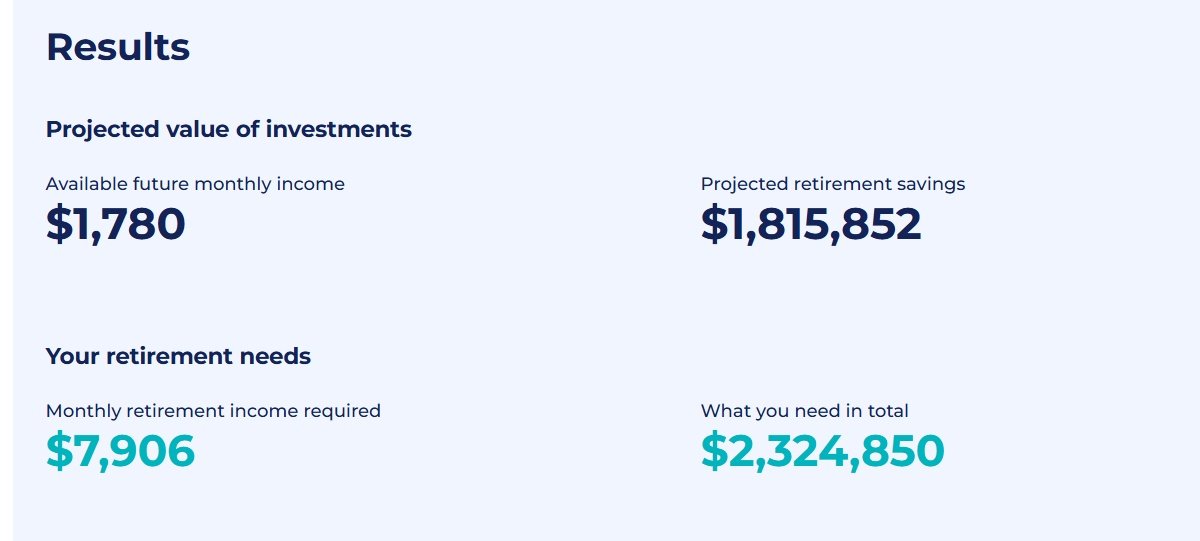
Running this profile through Planner Bee’s retirement calculator, the freelancer needs a total retirement pot of about $2,324,850 by age 65.
This figure may seem high, but it reflects the true cost of funding a long retirement without employer CPF contributions. Other income sources, such as property income, part-time work, family support, or inheritance, could reduce the required portfolio.
Step 5: Work out your monthly retirement savings target
The monthly savings required depends on investment return assumptions, time horizon, and current savings. Starting earlier reduces the monthly burden because investment growth has more time to compound.
Here is the reality check. If the freelancer sets aside $1,800 a month for 33 years at a 5% average annual return, the calculator projects retirement savings of about $1,815,852. That is still around $509,000 short of the $2,324,850 he needs. In other words, $1,800 a month, roughly one-third of his current income, is not quite enough on its own.
This is exactly why the earlier you start, the better. Closing that gap means either raising monthly contributions as income grows (he would need closer to $2,300 a month to fully fund the target), extending his working years, adding other income sources, or accepting a slightly lower retirement income. The point is not that $1,800 is wrong, but that freelancers should test their assumptions against a real calculation rather than a rule of thumb, and adjust as their income rises.
The five steps above can be summarised as follows:
| Step | What it calculates | Figure |
| 1 | Target income today | $3,500 / month |
| 2 | Inflated to age 65 (2.5% p.a., 33 years) | $7,906 / month |
| 3 | Less estimated CPF LIFE payout (FRS) | − $1,780 / month |
| 4 | Monthly retirement income gap | $6,126 / month |
| 5 | Total retirement pot needed (to age 95) | $2,324,850 |
| 6 | Projected savings at $1,800 / month (5%, 33 years) | $1,815,852 |
| 7 | Shortfall to close | ≈ $509,000 |
Here is the same worked example run through Planner Bee’s retirement calculator:
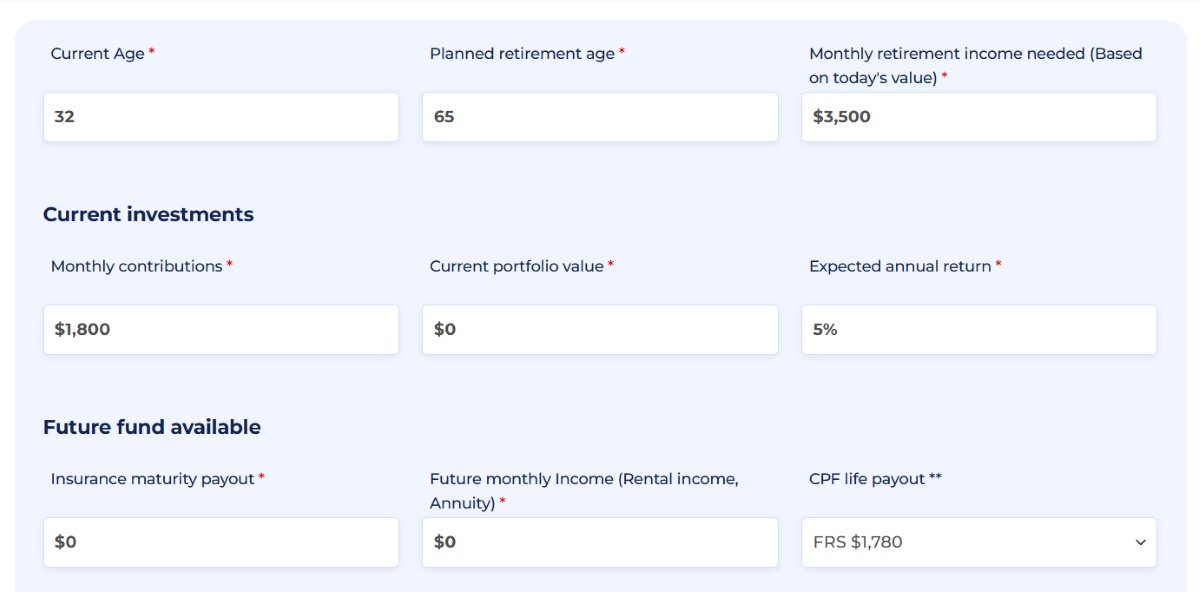
Pro-tip: Skip the manual maths! Planner Bee’s retirement calculator turns your age, income, CPF balances, and goals into a personalised monthly savings target in seconds.
Can freelancers rely on CPF alone when saving for retirement?

Most freelancers cannot rely on CPF alone for retirement unless they make regular voluntary CPF retirement contributions. CPF provides a strong foundation, but self-employed persons only have a compulsory obligation to MediSave.
CPF was designed around steady employment, where employer and employee contributions flow in every month. Freelancers do not receive employer CPF contributions, and compulsory MediSave contributions do not directly build CPF LIFE payouts.
Freelancers should treat CPF as one pillar of retirement planning. CPF offers government-backed interest rates and lifelong CPF LIFE payouts, but freelancers usually need to supplement CPF with SRS contributions, cash investments, and other retirement assets.
Best retirement strategies and practical tips for freelancers
Retirement strategies for freelancers in Singapore should address income volatility, tax planning, healthcare costs, CPF gaps, and long-term investment growth. A strong strategy turns irregular freelance income into a structured retirement plan.
Step 1: Calculate your annual cost of living in Singapore
Annual cost of living is the baseline amount needed to cover essential expenses for a year. Freelancers need this figure because it determines emergency fund size and how much income remains available for retirement.
For a single working professional renting a one-bedroom unit in a central area of Singapore, typical monthly costs may look like this:
| Category | Estimated monthly cost |
| Rent | ~S$3,000 |
| Utilities | ~S$250 |
| Public transport | ~S$250 |
| Dining out | ~S$300 |
| Groceries | ~S$300 |
| Healthcare (routine, out-of-pocket) | ~S$150 |
| Estimated total | ~S$4,000–4,250 |
Freelancers who live with family, rent a room, or live outside central Singapore may have a lower baseline. The goal is to calculate a realistic personal annual cost of living by multiplying the monthly baseline by 12.
Step 2: Build an emergency fund for irregular freelance income
An emergency fund protects freelancers from income gaps, medical expenses, and urgent personal costs. Freelancers usually need a larger emergency fund than employees because they do not receive a fixed monthly salary.
A practical target is 6–12 months of personal living expenses in a liquid, low-risk account. This buffer reduces the risk of withdrawing from retirement investments during slow work periods.
Step 3: Set aside money for tax as a freelancer
A tax reserve helps freelancers prepare for annual income tax because clients do not withhold tax from freelance payments. This habit prevents tax bills from disrupting savings plans.
Singapore’s resident tax rates are progressive:
| Chargeable income | Tax rate |
| First S$20,000 | 0% |
| Next S$10,000 | 2% |
| Next S$10,000 | 3.50% |
| Next S$40,000 | 7% |
| Next S$40,000 | 11.50% |
| Next S$40,000 | 15% |
| Next S$40,000 | 18% |
| Next S$40,000 | 19% |
| Next S$40,000 | 19.50% |
| Next S$40,000 | 20% |
| Next S$180,000 | 22% |
| Next S$500,000 | 23% |
| Above S$1,000,000 | 24% |
Source: IRAS Individual Income Tax Rates
For example, a freelancer with $66,000 of chargeable income would owe about $2,370 in tax, which equals an effective rate of about 3.6%. Many moderate-income freelancers may find that setting aside 5–10% of each payment creates a reasonable tax buffer, while higher earners should reserve more based on their tax bracket.
Step 4: Treat retirement savings as a fixed monthly expense
Treating retirement savings as a fixed expense means allocating money to retirement before discretionary spending. This helps freelancers protect long-term goals from lifestyle creep.
Once the emergency fund and tax reserve are healthy, freelancers can allocate a fixed percentage of each incoming payment towards CPF top ups, SRS contributions, or investments.
Step 5: Save more during high-income freelance months
Surplus income from strong months should strengthen emergency savings or retirement investments. This prevents one high-income month from creating spending habits that become difficult to sustain during slower periods.
Freelancers should direct excess income to the emergency fund first if it is below target. Once the emergency fund is complete, they can direct the surplus towards CPF, SRS, or long-term investments.
How freelancers can diversify beyond CPF for retirement
Diversifying beyond CPF means using additional retirement savings tools so freelancers are not dependent on one source of retirement income. This matters because CPF retirement contributions are voluntary for self-employed persons.
Freelancers in Singapore commonly use the following retirement savings options to supplement CPF and build long-term income:
- Voluntary CPF top ups to the Special Account before age 55 or Retirement Account after age 55, which benefit from CPF’s guaranteed interest rates.
- Supplementary Retirement Scheme contributions, a voluntary scheme that lets Singapore Citizens and PRs contribute up to S$15,300 a year (S$35,700 for foreigners), reducing chargeable income while the funds are invested for retirement.
- A diversified investment portfolio, such as equities, bonds, and REITs, for long-term savings outside CPF and SRS.
- Cash savings for short-term liquidity, especially during periods of irregular income.
CPF can provide stability, while investments outside CPF and SRS can provide flexibility and growth potential. Freelancers should balance guaranteed returns, liquidity needs, and investment risk.
Read more: Should You Prioritise a CPF Top Up Strategy in Singapore?
How to start a retirement fund as a freelancer

A retirement number is the estimated amount of savings and investments needed to support your desired retirement lifestyle. Freelancers should calculate this number because they do not have employer CPF contributions to narrow the retirement gap automatically.
Use this five-step framework:
- Decide on your target monthly retirement income in today’s dollars.
- Adjust that figure for inflation based on the years left until retirement.
- Estimate your likely CPF LIFE payout based on current and planned CPF contributions.
- Subtract the CPF LIFE estimate from your inflation-adjusted target income.
- Convert the income gap into a required investment portfolio and monthly savings target.
A spreadsheet can help, but a retirement calculator makes the process faster. Planner Bee’s retirement calculator lets freelancers input age, income, CPF balances, current savings, and target retirement lifestyle to estimate a personalised monthly savings target.
Planning for retirement in Singapore as a freelancer
Learning how to save for retirement as a freelancer means accepting that freelancing in Singapore offers flexibility but shifts retirement responsibility onto the individual. Without employer CPF contributions, freelancers must calculate their retirement number, understand annual living costs, build an emergency fund, reserve money for tax, and save consistently.
Freelancers can make retirement planning manageable by using a structured system. Start with essential expenses, protect cash flow with an emergency fund, contribute voluntarily to CPF or SRS where suitable, and invest regularly for long-term growth.
Read more: 5 Steps To Help You Start Investing for Retirement in Singapore
Frequently asked questions
How much should freelancers save monthly for retirement in Singapore?
Freelancers in Singapore should base monthly retirement savings on income, expenses, CPF balances, retirement age, and target lifestyle. There is no fixed amount that applies to everyone. As a starting discipline, some freelancers use 20–30% of net income as a savings and investment benchmark, then adjust the figure using a personalised retirement calculation.
Should freelancers prioritise CPF top ups or investing?
Freelancers can use both CPF top ups and investing. CPF top ups provide government-backed interest rates and can support future CPF LIFE payouts. Investing outside CPF provides more flexibility and potentially higher long-term returns, but it carries more risk. Many freelancers combine CPF, SRS, and diversified investments.
What investments are suitable for freelancers in Singapore?
Suitable investments depend on risk appetite, time horizon, income stability, and cash buffer size. Freelancers with irregular income should usually build a larger emergency fund before investing heavily. Long-term portfolios may include equities, bonds, REITs, or diversified funds, depending on the individual’s goals and risk tolerance.
Do freelancers need to pay tax?
Yes. Freelancers in Singapore need to pay tax on freelance income. IRAS treats freelance income as trade income, and freelancers must declare net trade income annually. Because no employer withholds tax from freelance payments, freelancers should set aside a tax reserve from each payment received.
How much CPF should freelancers contribute?
Freelancers must contribute to MediSave when annual net trade income exceeds S$6,000. This freelancer CPF contribution depends on age and income. Contributions to the Ordinary Account, Special Account, or Retirement Account are voluntary for self-employed persons and should depend on retirement goals, liquidity needs, and desired CPF LIFE payouts.
Should self-employed people use SRS?
Self-employed people can use SRS if they want tax relief and can set money aside until retirement age. SRS contributions reduce chargeable income and allow funds to be invested. However, SRS works best for freelancers who do not need the money in the short term.