Landed properties in Singapore are homes built on privately owned land, and they include terrace houses, semi-detached houses, detached bungalows and cluster houses. In each case the buyer owns both the building and the plot beneath it.
This ownership of land, rather than just a strata unit, commands the premium and drives the aspiration to upgrade. Many buyers see a landed home as the ultimate property upgrade because it offers more space, more privacy and a stronger sense of status.
Before fixating on that goal, decide whether you are making a practical housing decision or chasing the “Singapore dream upgrade” narrative.
Key takeaways
- Landed property in Singapore is often driven by aspiration, and that aspiration may not align with financial readiness or long-term goals.
- Income alone does not determine affordability. Capital, meaning cash and CPF for the downpayment, Buyer’s Stamp Duty (BSD) and, for many upgraders, Additional Buyer’s Stamp Duty (ABSD), usually forms the larger barrier.
- A higher salary increases loan eligibility, but financing rules such as the loan-to-value (LTV) limit and Total Debt Servicing Ratio (TDSR), plus real monthly cash flow, determine sustainability.
- Ongoing costs such as maintenance, renovation, property tax and upkeep significantly affect finances beyond the purchase price.
- Allocating a large share of wealth into one landed property carries opportunity costs, including reduced liquidity and fewer investment options.
- Not upgrading to landed, especially where it stretches finances, often proves the more prudent and flexible decision.
Should you aim for a landed property?
This section weighs aspiration against financial readiness before you commit capital. For many buyers, lifestyle rather than readiness drives the desire for Singapore landed property.
Wanting more space or autonomy is reasonable, but landed homes carry significantly higher financial commitments and opportunity costs, and stretching for one can compromise your long-term flexibility.
The better question is not only whether you can afford it, but whether you should. That answer rests on your capital reserves, your cash flow comfort and your opportunity cost, not on salary alone.
How much landed properties in Singapore actually cost
Landed homes span several property types with very different price points, because land value, location, tenure and plot size each carry significant weight. Headline prices are misleading when you view them in isolation. The indicative price ranges for landed properties are as follows.
| Property type | Typical price range |
| Terrace house | Around S$3M–S$6M |
| Semi-detached house | S$4M–S$10M+ |
| Detached house | S$10M–S$30M+ |
| Cluster house | S$2.5M–S$5M |
Note: Indicative ranges compiled from PropertyGuru transaction listings observed in the first half of 2026. Figures are directional rather than statistical averages, and vary by district, tenure, land size and condition.
These figures vary widely by district, land size and condition. A freehold terrace in District 15 commands a very different price from a leasehold one in the outskirts. Income alone does not determine affordability. A buyer earning $20,000 a month with limited savings may be less prepared than someone earning less but holding substantial capital.
Affordability reality check: Income, loans and cash flow

Financing rules govern property affordability in Singapore, chiefly the Total Debt Servicing Ratio (TDSR), which caps total monthly debt obligations at 55% of gross monthly income. The benchmarks below assume an interest rate of about 4%, a loan tenure of 25 to 30 years, and no other significant debt.
Banks assess TDSR on a stress-test rate, which is the higher of 4% per annum or the loan’s thereafter rate, rather than the rate you actually contract. The 4% figure used here therefore reflects the regulatory floor, not a market rate.
Financial institutions must also apply a minimum 30% haircut to variable income such as commission, bonus, allowance and rental income, so only 70% of it counts toward TDSR. IRAS assesses self-employed income from the Notice of Assessment the same way, and rental income only counts when a valid tenancy agreement with at least six months remaining supports it.
For high earners who pay leans toward bonuses, commission or rental, this materially reduces the loan they qualify for. A household showing $40,000 a month that is half variable gets assessed closer to $34,000.
Under these assumptions, every $1M of loan requires roughly $4,500 to $5,000 in monthly repayments, because a 25-to-30-year amortisation at 4% produces that repayment band per million borrowed. This means the following.
- A $3M property (75% loan of $2.25M) requires roughly $10,000 to $11,000 per month.
- A $5M property (75% loan of $3.75M) requires roughly $17,000 to $19,000 per month.
The monthly household income benchmarks below keep those repayments within the 55% TDSR limit for landed housing.
- Around $18,000 to $20,000 per month for entry-level landed (cluster or low-end terrace).
- Around $30,000 to $40,000 per month for mid-range landed.
- Significantly higher for prime districts.
Qualifying for the loan does not mean you can afford it comfortably. Your mortgage payments should not leave your household asset-rich but cash-poor.
Read more: Is This Property Affordable? Here’s How You Can Tell in Singapore
The barrier is capital, not income
Income determines how much you can borrow, while capital determines whether you can enter the market at all. These two constraints stay distinct, and capital usually binds first. For a first private property purchase financed by a bank loan, the maximum loan-to-value (LTV) limit sits at 75%, so the minimum downpayment is 25%.
- You must pay at least 5% of the purchase price in cash.
- You may pay the remaining 20% in cash or CPF.
The LTV limit falls to 45% with one outstanding housing loan and 35% with two or more. This matters directly to upgraders. A retained existing property lowers your LTV limit, which raises the cash downpayment, at the same time as it triggers ABSD, so both constraints compound for anyone who has not yet sold. A shorter maximum tenure or older borrower age can reduce the LTV limit further.
For a $4M landed home at 75% LTV, the total downpayment reaches $1M, of which the minimum cash portion is $200,000 (5%). On top of the downpayment, budget for the following.
- Buyer’s Stamp Duty (BSD): Roughly $179,600 on a $4M residential property, calculated on the tiered BSD rates that rise to 6% on value above $3M, and payable within 14 days of exercising the Option to Purchase.
- Additional Buyer’s Stamp Duty (ABSD), where applicable. A Singapore Citizen buying a second residential property pays 20% ($800,000 on $4M), rising to 30% for a third or subsequent property. This applies unless you sell your existing home first or qualify for ABSD remission on a replacement matrimonial home.
- Legal fees and miscellaneous costs
A citizen buying a $4M landed home as a first property therefore needs roughly $1.4M to $1.6M in liquid or semi-liquid assets upfront, covering the downpayment plus BSD and costs. If ABSD applies because you have not sold the existing home, the upfront requirement rises well beyond $2M. This explains why many high-income earners still cannot afford landed. They lack the accumulated capital.
Read more: What Homeowners Should Know Before Upgrading Property in Singapore
The upgrade path: How most buyers reach landed
Most landed homeowners did not start there. They climbed a property ladder that built capital at each step. A typical progression runs as follows.
- HDB flat
- Upgrade to a mass-market condo
- Move to a larger or multiple properties
- Eventually upgrade to a landed house in Singapore
Each step builds equity through capital appreciation, accumulates savings and leverages gains from previous sales. This laddered approach generally proves more sustainable than leaping directly into landed housing.
Read more: Does Staying in an HDB Cost More Than Upgrading to a Condo?
The hidden costs of owning a landed house in Singapore
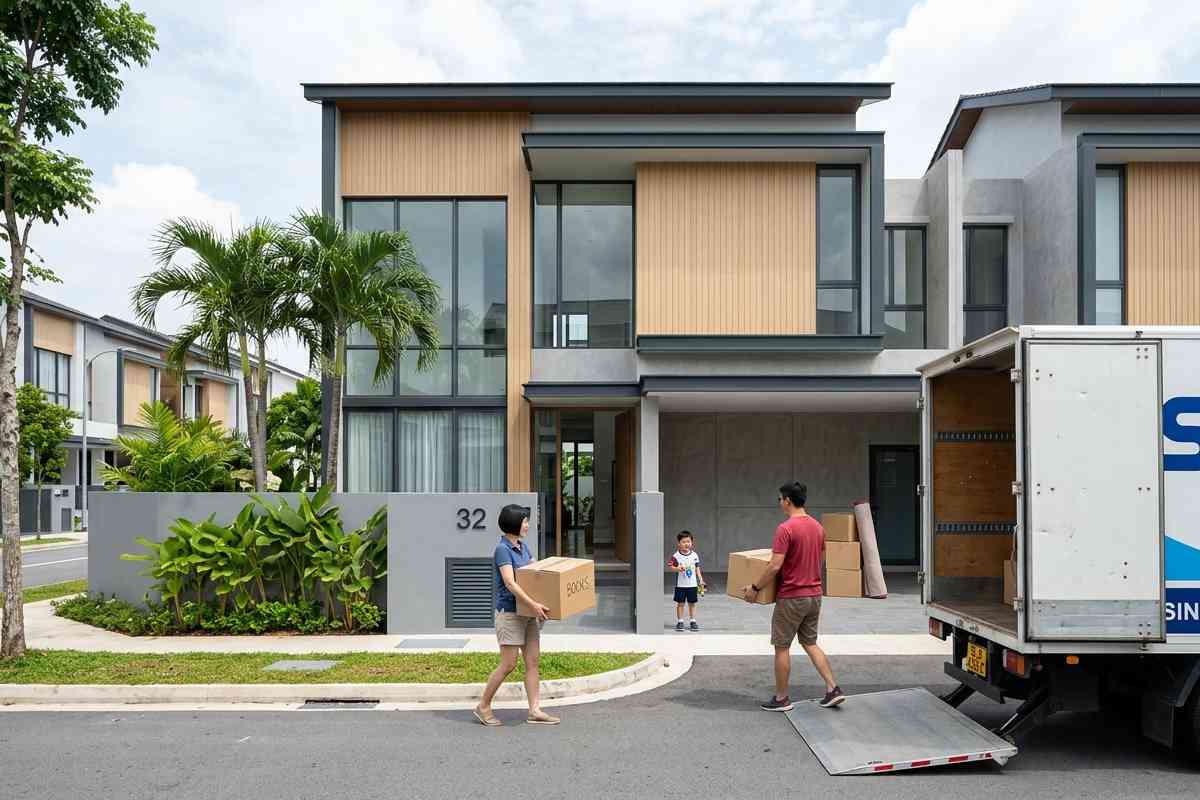
The purchase price forms only part of the cost, because landed homes carry ongoing expenses well above those of apartments, and no management corporation absorbs them. Key recurring costs include the following.
- Maintenance and repairs: Roofing, plumbing, façade upkeep and pest control.
- Renovation: Often S$150,000 to S$500,000 or more for older homes.
- Property tax: A higher annual charge based on the property’s annual value, under progressive owner-occupier or non-owner-occupier rates.
- Utilities: Larger homes mean higher electricity and water bills.
- Long-term upkeep: Structural wear and tear over time.
Unlike a condo, a landed home has no management corporation to handle maintenance, so every cost falls on the owner.
Opportunity cost: What you give up
Committing millions to a single property carries trade-offs that compound over the holding period. By locking a large share of your net worth into a landed home, you may give up the following.
- Investment opportunities in equities or diversified portfolios.
- Liquidity and financial flexibility.
- The ability to generate passive income from other assets.
Landed homes may appreciate over time, but they do not always build wealth as efficiently as diversified investments.
When not buying landed is the smarter decision
Choosing not to buy a landed property can prove a financially sound decision rather than a failure. Reconsider the purchase if any of the following apply.
- Buying would significantly deplete your cash reserves.
- Monthly repayments would strain your lifestyle.
- You prefer flexibility over a long-term financial commitment.
- You can meet similar lifestyle goals through other housing, such as large condos or penthouses.
Aim not to own the “best” property, but to build a sustainable financial future.
Read more: How To Better Understand Mortgage Affordability After Cooling Measures?
What salary do you really need?

The salary required for a landed house in Singapore scales with property price, existing debt and available capital, so no single figure applies. The benchmarks below assume no other major loan commitments and a mortgage held within the TDSR ceiling.
- Entry-level landed: Household income of around $18,000 to $25,000 per month, with substantial savings.
- Mid-range landed: Around $30,000 to $50,000 per month.
- High-end landed: $50,000 or more per month.
The table below breaks down the Singapore landed property price against required income, with all figures in Singapore dollars (SGD).
| Property price | Estimated loan (75%) | Monthly repayment* | Est. household income required** |
| $3M | $2.25M | $10K–$11K | $18K–$20K |
| $4M | $3M | $13K–$14K | $24K–$26K |
| $5M | $3.75M | $17K–$11K | $30K–$35K |
| $6M | $4.5M | $20K–$23K | $36K–$42K |
| $8M | $6M | $27K–$30K | $49K–$55K |
| $10M | $7.5M | $34K–$38K | $62K–$70K |
*Monthly repayment estimated at around 4% interest over 25 to 30 years.
**Income required to keep the mortgage within the 55% TDSR threshold, assuming no other significant debt. Actual figures rise if you carry car loans, personal loans or other commitments, or if a large share of your income counts as variable and takes the 30% haircut.
Beyond income, buyers typically need significant capital, meaning a 25% downpayment plus BSD, and ABSD where applicable, often well over $1M in total, alongside a stable income and long-term financial discipline.
Conclusion
Affordability comes down to balance rather than salary alone. Work through these steps before you commit to a landed home in Singapore.
- Tally your investable capital first. Add up your cash and usable CPF, then subtract the full 25% downpayment, BSD, any ABSD and legal fees. If the remainder leaves you without a comfortable reserve, keep building capital before you buy.
- Assess your income after the haircut, not before. Split your income into fixed and variable, apply the 30% haircut to the variable portion, and check the adjusted figure against the income benchmarks in the table above.
- Sell your existing home before you commit where possible. Doing so restores your 75% LTV limit and avoids paying ABSD upfront, which frees up more than $1M on a $4M purchase.
- Stress-test your monthly cash flow at 4%, not at today’s rate. If the repayment crowds out savings, investments or lifestyle, size down the property or wait.
- Compare landed against the alternative. Price a large condo or penthouse that meets the same lifestyle goals, then decide whether the extra cost of landed earns its place in your plan.
For many households, the most disciplined move on landed properties in Singapore is to keep building capital first, then upgrade from a position of strength.
Frequently asked questions
What salary do you need to buy a landed property in Singapore?
There is no single salary. A household generally needs around $18,000 to $20,000 per month for an entry-level landed home near $3M, and $30,000 to $40,000 per month for a mid-range home around $5M. These figures keep the mortgage within the 55% TDSR limit and assume you hold no other major debt.
How much cash do you need upfront for a landed house in Singapore?
For a $4M landed home bought as a first property, you need roughly $1.4M to $1.6M upfront. This covers the 25% downpayment (with at least 5% in cash), Buyer’s Stamp Duty of about $179,600, and legal and miscellaneous costs. If ABSD applies because you have not sold your existing home, the upfront figure rises beyond $2M.
Is income or capital the bigger barrier to buying landed property?
Capital usually forms the bigger barrier. Income sets how much you can borrow, but the downpayment and stamp duties demand a large cash and CPF sum that many high earners have not accumulated. This is why plenty of high-income earners still cannot buy landed.
Can you use CPF to buy a landed property in Singapore?
Yes, you can use your CPF Ordinary Account for part of the 25% downpayment, though at least 5% of the purchase price must come from cash. You can also use CPF OA to pay Buyer’s Stamp Duty. CPF cannot be used for the initial 5% cash portion or for ongoing maintenance and upkeep.
Do you pay ABSD when upgrading to a landed home?
You pay ABSD if you buy the landed home before selling your current property, because it counts as your second property. A Singapore Citizen pays 20% in that case. If you sell your existing home first, or dispose of it within the remission window on a replacement matrimonial home, you can avoid ABSD or claim a refund, subject to conditions.
Which is the more efficient use of money, a landed property or investments?
It depends on your goals. Landed homes can appreciate, but they lock up liquidity and often build wealth less efficiently than a diversified portfolio. Weigh the lifestyle value of landed housing against the returns and flexibility you give up by tying most of your net worth to one property.