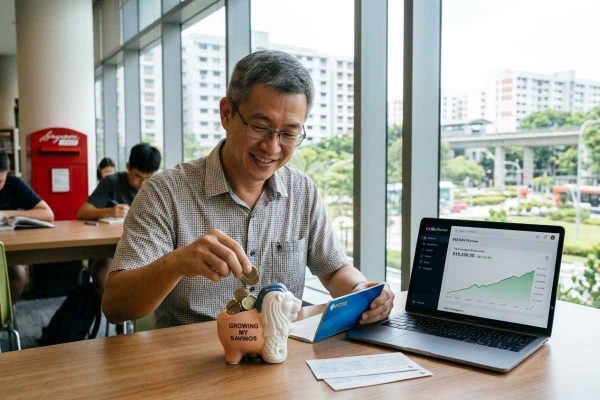

Cash provides stability, liquidity, and immediate access to funds. However, holding excessive cash beyond essential financial needs can reduce long-term wealth due to inflation and low returns. Holding “too much cash” refers to maintaining savings beyond necessary liquidity buffers, resulting in inefficient capital allocation and declining purchasing power over time.
Key takeaways
- Cash ensures liquidity but loses value when inflation exceeds interest rates.
- Excessive cash holdings create “cash drag”, limiting long-term growth.
- Structuring cash by purpose improves financial efficiency.
- Ideal cash levels depend on expenses, income stability, and planned financial needs.
- Surplus cash should be gradually redirected into higher-yield or investment options.
Why Singaporeans tend to hold large cash balances
Singapore households typically maintain higher cash reserves due to structural and behavioural factors.
| Factor | Explanation |
| High cost of living | Housing, healthcare, and education require significant liquidity |
| Economic uncertainty | Events such as COVID-19 reinforced the need for accessible savings |
| Cultural prudence | Strong emphasis on saving and financial discipline |
Maintaining liquidity supports financial stability. However, excessive accumulation can reduce efficiency over time.
When “safe” becomes inefficient
Cash reduces exposure to market volatility but remains vulnerable to inflation, which erodes purchasing power over time.
This effect is commonly described as cash drag, where holding excessive funds in low-interest accounts limits overall portfolio growth.
Real return provides a clear measurement of this impact:
Real Return = Interest Rate – Inflation Rate
| Scenario | Value |
| Interest rate | 2% |
| Inflation rate | 4% |
| Real return | –2% |
If a savings account earns 2% interest while inflation is 4%, the real return is –2%. This means the nominal balance remains stable, but its purchasing power declines.
What cash is meant to do

Cash should be allocated based on defined financial purposes rather than treated as a single pool of savings.
A practical way to structure cash is to divide it into different categories based on its purpose and time horizon. This approach helps ensure that liquidity supports both short-term needs and long-term financial efficiency.
1. Emergency fund
The emergency fund forms the foundational layer of liquidity, designed to protect against unforeseen financial disruptions.
Emergency fund usage typically includes the following financial scenarios:
- Sudden job loss
- Medical emergencies
- Urgent family needs
- Major home repairs
| Profile type | Recommended coverage |
| Employees with regular income stream | 6-9 months |
| Irregular or self-employed persons | 9–12 months |
2. Short-term planned expenses
This category covers planned financial obligations within the next one to two years.
| Common expenses | Examples |
| Housing-related | Renovation, down payment |
| Life events | Wedding |
| Education | School fees |
| Lifestyle | Travel, large purchases |
These funds should remain in low-risk, liquid instruments to preserve capital.
3. Psychological buffer
This category refers to extra cash that is not strictly required for emergencies or planned expenses but is kept for personal comfort and peace of mind.
In practical terms, it is the additional amount of savings that helps you feel financially secure beyond your basic safety net. For example, even after setting aside 6 months of emergency expenses, some individuals may still prefer to keep extra cash to feel more confident handling unexpected situations.
This buffer varies depending on individual risk tolerance, income stability, and personal experiences. Someone with a stable job may feel comfortable with less, while someone who is self-employed or supporting dependents may prefer holding more.
While maintaining a psychological buffer can reduce financial stress, excessively large amounts may lead to cash drag, where money loses value over time due to inflation and low returns.
How much cash is “too much”?

There is no universal threshold. However, most individuals only need enough cash to cover their emergency fund and short-term planned expenses.
As a general guide, this typically means holding:
- 6 to 9 months of essential expenses for individuals with stable income.
- 9 to 12 months or more for those with variable income or higher financial responsibilities.
- Additional cash for planned expenses within the next one to two years.
Cash holdings that significantly exceed these ranges without a clear purpose may indicate excess liquidity.
Excessive cash holdings can be identified through the following indicators:
| Indicator | What it means |
| >12 months of expenses in cash | Likely exceeds practical liquidity needs |
| Returns below inflation | Purchasing power is declining |
| Avoiding investing due to fear | Indicates behavioural rather than strategic decision |
These factors indicate inefficient capital allocation rather than prudent financial planning.
To determine your exact cash requirement, use the step-by-step approach below.
Read more: Best Bank Fixed Deposit Rates in Singapore for Savers
How to calculate your ideal liquidity level

A structured calculation ensures sufficient liquidity without excessive idle cash.
Step 1: Calculate monthly essential expenses
Begin by determining the minimum amount you need each month to cover your core living costs.
This includes non-negotiable expenses such as housing, utilities, food, insurance, transportation, and minimum loan repayments. The objective is to establish a reliable baseline that reflects what you must spend to maintain financial stability.
What counts as “essential” will differ between individuals. Factors such as dependents, lifestyle choices, and existing financial commitments will influence this figure.
Example: If your essential monthly expenses total S$3,000, this amount forms the basis for your liquidity planning.
Step 2: Build your emergency fund
Once your baseline expenses are defined, determine how many months of coverage you want to maintain.
A commonly used guideline is 3 to 6 months of essential expenses. A more conservative range of nine to twelve months may be appropriate for individuals with variable income, dependents, or greater job uncertainty.
This is not a fixed rule. The appropriate level depends on your income stability, financial obligations, and personal risk tolerance.
Example: With monthly expenses of S$3,000 and a six-month buffer, your emergency fund would be S$18,000.
Read more: What’s an Emergency Fund and How Much is Enough?
Step 3: Add short-term planned expenses
Next, account for any upcoming expenses that you expect within the next one to two years.
These may include planned costs such as renovations, education fees, major purchases, or travel. Because these expenses have a defined timeline, the funds should remain easily accessible and protected from market volatility.
The amount required will depend entirely on your personal plans and financial priorities. Some individuals may have significant upcoming commitments, while others may not.
Example: If you are planning a renovation costing S$25,000 and a trip costing S$5,000, your total short-term cash requirement would be S$30,000.
Illustrative liquidity examples
These examples are for illustration only and do not represent fixed recommendations. Actual liquidity needs will vary based on individual financial circumstances.
Liquidity requirements vary significantly based on life stage and financial responsibilities.
| Profile | Monthly expenses | Emergency fund | Planned expenses | Total liquidity |
| Young professional | S$2,500 | S$15,000 | S$5,000 | ~S$20,000 |
| Mid-career with family | S$6,000 | S$54,000 | S$30,000 | ~S$84,000 |
| Self-employed | S$4,000 | S$48,000 | S$10,000 | ~S$58,000 |
Where should excess cash go?
Excess cash should be redeployed gradually to improve financial efficiency while maintaining adequate liquidity.
| Option | Purpose |
| Diversified portfolios | Long-term growth |
| Retirement savings | Future financial security |
| Bonds / fixed income | Stable returns |
| High-yield savings | Improved short-term returns |
The objective is to reduce idle cash while preserving financial security.
Read more: What Beginner Investors Should Know Before Getting Started
Deposit insurance and bank limits in Singapore
In Singapore, eligible deposits are protected under the Singapore Deposit Insurance Corporation (SDIC) scheme. This scheme provides coverage of up to S$100,000 per depositor per bank for insured deposits.
This means that if a bank fails, deposits up to this limit remain protected. For individuals holding balances above S$100,000, any amount exceeding the insured limit is not covered under the scheme.
As a result, individuals with larger cash holdings may choose to spread their funds across multiple banks to increase the total amount protected under deposit insurance.
Should you split your money across banks?

Splitting your savings across multiple banks can serve both protective and practical purposes.
From a protection standpoint, distributing funds allows you to stay within the S$100,000 deposit insurance limit per bank, thereby maximising coverage under the SDIC scheme. From an optimisation perspective, different banks may offer varying interest rates or promotional savings accounts, allowing you to improve returns on your cash holdings.
That said, Singapore’s banking system is widely regarded as stable and well-regulated. For most individuals, splitting funds across banks is primarily a strategy for optimising interest rates rather than mitigating concerns about bank failure.
Conclusion
Cash remains a critical component of financial planning, providing stability and liquidity. However, excessive cash holdings reduce long-term financial efficiency due to inflation and low returns.
An effective strategy balances liquidity with growth by maintaining structured cash reserves while deploying excess funds productively.
The objective is not to eliminate cash, but to ensure it serves a defined financial purpose rather than remaining idle.