

Singapore offers one of the most structured startup funding ecosystems in Asia, with access to government support, private capital, and scalable financing options. Understanding how these funding sources work is essential for making informed decisions at different stages of business growth.
Key takeaways
- Startup funding refers to the capital required to build, operate, and scale a business.
- Singapore offers four primary funding sources including government grants, business loans, equity funding, and bootstrapping.
- Government grants provide non-dilutive funding but require strict eligibility and compliance.
- Business loans preserve ownership but introduce repayment obligations and interest costs.
- Angel investors and venture capital provide funding in exchange for equity and growth expectations.
- Bootstrapping allows founders to retain full control but limits growth based on available capital.
Startup funding refers to the financial capital required to develop products, hire talent, and scale operations. Startups operate within a structured ecosystem supported by strong government investment and access to private capital.
Singapore has committed S$37 billion under the Research, Innovation and Enterprise 2030 (RIE2030) plan to strengthen its research and innovation ecosystem. This investment is designed to deepen research capabilities and drive innovation across key sectors such as manufacturing, sustainability, and the digital economy.
As a result, startups in Singapore can access multiple funding options across different stages of growth. These options differ in ownership impact, repayment obligations, and scalability, making it essential to align funding decisions with business goals.
Why funding is one of the first major decisions for new businesses

Funding determines how a startup builds its product, scales operations, and manages ownership. Each funding source affects financial risk, control, and long-term strategy.
Startup funding options in Singapore fall into four primary categories based on capital structure:
- Government grants: Provide funding without requiring equity dilution.
- Business loans and SME financing schemes: Provide debt-based capital with repayment obligations.
- Angel investors and venture capital: Provide equity funding alongside mentorship and networks.
- Bootstrapping and personal funding: Involves using personal savings or internal revenue.
These funding types are interconnected. For example, startups often begin with bootstrapping, move to grants, and later raise equity funding or venture debt as they scale.
Read more: How To Start Your Own Business in Singapore
Government grants for startups in Singapore
Government grants provide structured funding to support innovation, early-stage development, and business expansion. These grants reduce financial risk but require strict eligibility compliance and defined project outcomes.
1. Startup SG Founder
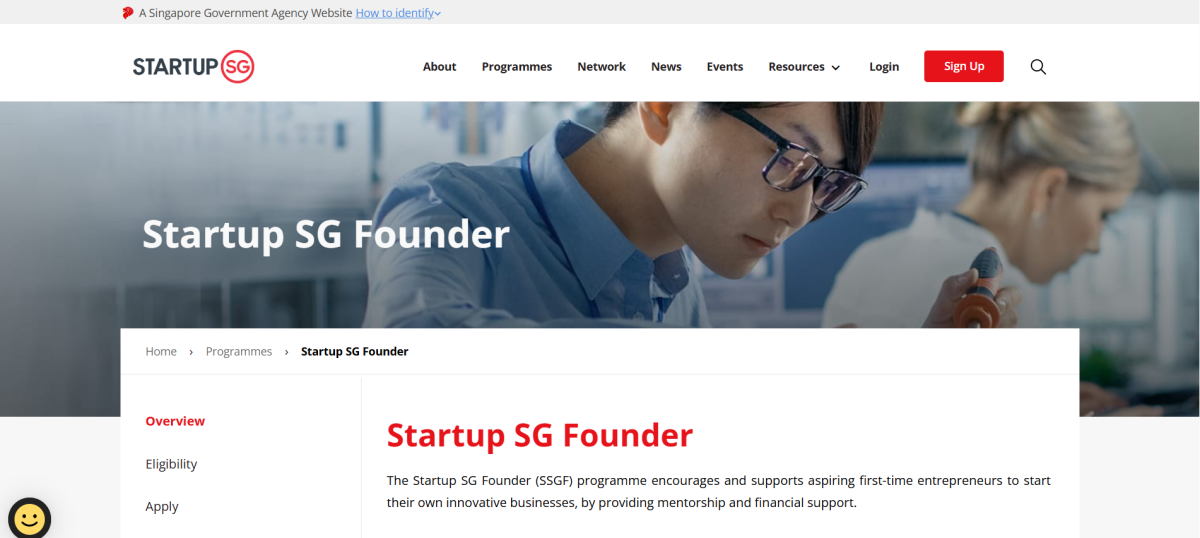
Startup SG Founder (SSGF) supports first-time entrepreneurs in building innovative businesses in Singapore. It provides funding of S$20,000 to S$50,000, along with mentorship through Accredited Mentor Partners (AMPs).
Eligibility & key requirements
To qualify, startups must meet the following criteria:
- First-time founder as the main applicant, with full-time commitment.
- Co-investment requirement of S$1 for every S$1 of grant.
- At least 30% ownership held by founders.
- Company must be registered in Singapore as a Private Limited entity and be less than six months old.
- At least 51% local ownership held by Singapore Citizens or Permanent Residents.
- Core business operations must be based in Singapore.
- Must not have received prior government funding.
2. Startup SG Equity
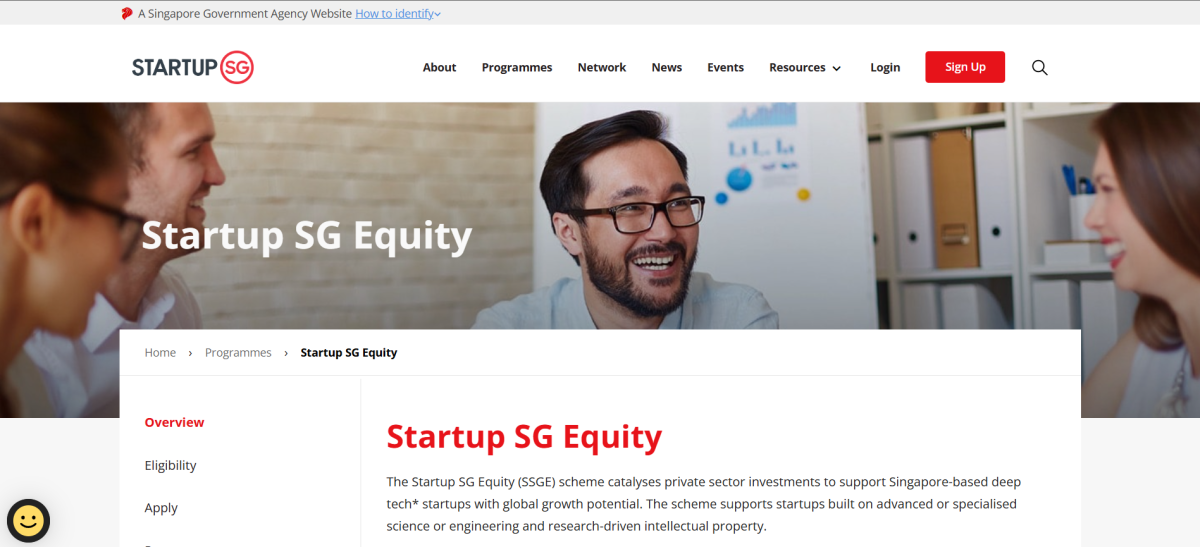
Startup SG Equity is a co-investment programme that supports deep tech startups by matching private investment. It targets companies building proprietary technologies in sectors such as AI, biotechnology, sustainability, and advanced manufacturing.
Eligibility & key requirements
- Singapore-based private limited company with a maximum age of 10 years.
- Must develop or own innovation in Singapore.
- Must operate in a deep tech sector.
Funding tracks
Startup SG Equity offers three distinct funding tracks, each designed for different stages of startup growth and investment needs:
| Track | Description | Key details |
| Early-stage (co-investment) | Government co-invests alongside private investors to support early-stage deep tech startups | Up to S$12 million funding Matching ratio depends on stage |
| Growth-stage (direct investment) | Direct investment into more mature startups with demonstrated progress | Requires existing funding, proven traction, and scalable business model |
| Fund-of-funds (VC firms) | Investment into venture capital firms that deploy capital into deep tech startups | Minimum S$30 million fund size Must invest in Singapore deep tech startups Requires strong track record |
3. Startup SG Tech
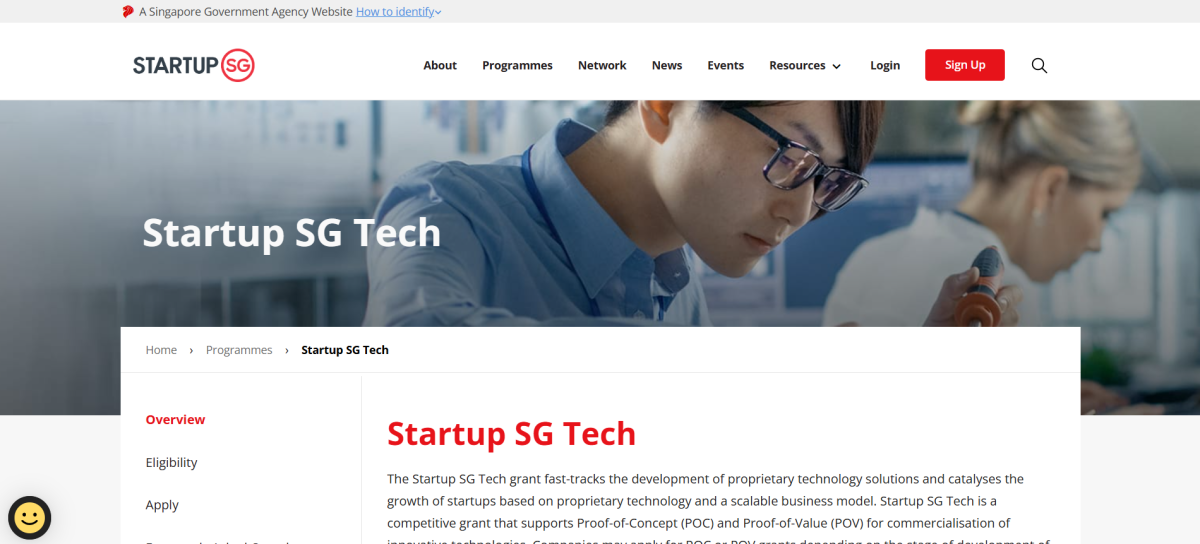
Startup SG Tech supports deep-tech startups in Singapore to develop and commercialise innovative solutions. It is designed for companies building proprietary technology with strong potential for real-world application and scalability.
The grant is structured around two development stages:
- Proof-of-Concept (POC): Up to S$400,000 to validate technical feasibility.
- Proof-of-Value (POV): Up to S$800,000 to validate commercial viability and market demand.
This funding is most relevant for startups operating in deep-tech sectors such as AI, cybersecurity, robotics, biomedical technology, agritech, and clean technology.
Eligibility criteria
Startups must meet the following core requirements:
- Registered in Singapore.
- Less than 10 years old and fewer than 200 employees.
- At least 30% locally owned by Singapore citizens or permanent residents.
- Developing deep-tech innovation with intellectual property and commercial potential.
Key conditions
- Research and development must be conducted in Singapore.
- Applications must be submitted before the project begins.
- Proof-of-Value projects require demonstrated market validation.
Unlike most government grants, Startup SG Tech may involve equity participation by Enterprise Singapore in future funding rounds, which can affect ownership structure as the company grows.
4. Productivity Solutions Grant (PSG)
The Productivity Solutions Grant (PSG) supports SMEs in Singapore by funding the adoption of IT solutions and equipment that improve operational efficiency. It covers up to 50% of eligible costs, capped at S$30,000, making it suitable for businesses looking to automate processes and reduce costs.
To qualify, businesses must meet the following requirements:
- Registered and operating in Singapore.
- At least 30% local ownership by Singapore Citizens or Permanent Residents.
- Annual revenue of S$100 million or below, or workforce of 200 employees or fewer.
- IT solutions or equipment must be used in Singapore.
- Application must be submitted before any payment is made to vendors.
5. Enterprise Development Grant (EDG)
The Enterprise Development Grant (EDG) supports Singapore businesses undertaking projects to grow, innovate, or expand internationally. It funds initiatives that improve operations, build new capabilities, or support market expansion. EDG covers costs such as consultancy, software and equipment, and internal manpower.
Eligibility & key requirements
- Registered and operating in Singapore.
- At least 30% local ownership by Singapore Citizens or Permanent Residents.
- Must be financially ready to complete the project.
Business loans and SME financing options in Singapore
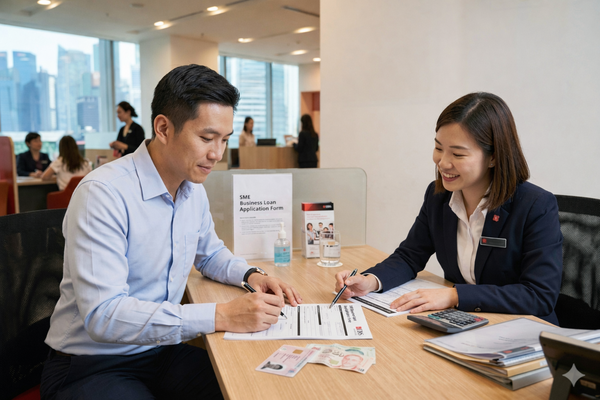
Business loans and SME financing schemes provide startups with access to capital while preserving ownership. These options are typically more suitable for businesses with steady revenue or clear growth plans, as they require repayment with interest.
In Singapore, the Enterprise Financing Scheme (EFS) plays a central role in improving access to business loans. Under this scheme, Enterprise Singapore shares between 50% and 70% of the loan default risk with financial institutions, depending on the company’s age. This risk-sharing structure encourages lending and makes financing more accessible to startups and SMEs.
The EFS supports several loan types designed for different business needs:
- SME Working Capital Loan: Supports day-to-day operational expenses.
- SME Fixed Assets Loan: Funds long-term investments such as equipment and property.
- Venture Debt Loan: Supports high-growth startups without requiring traditional collateral.
- Trade Loan: Supports trade financing and short-term cash flow needs.
Each loan type serves a specific purpose and is structured differently in terms of loan size, repayment period, and eligibility. The following sections provide detailed breakdowns of each financing option.
1. SME Working Capital Loan (EFS-WCL)
The SME Working Capital Loan under the Enterprise Financing Scheme helps Singapore businesses manage day-to-day operational cash flow, including expenses such as payroll, rent, and inventory.
The loan is issued by participating financial institutions, with Enterprise Singapore sharing 50% to 70% of the lending risk. This risk-sharing structure improves access to financing, particularly for younger businesses.
Key loan details
- Maximum loan amount: Up to S$500,000 per borrower
- Repayment period: Up to 5 years
- Interest rate: Determined by the lending bank
Eligibility
- Must be registered and operating in Singapore.
- Must have at least 30% local ownership.
- Must meet SME criteria (e.g. revenue and employee limits).
2. Venture Debt (EFS-VD)
The Venture Debt scheme supports high-growth startups that may not qualify for traditional loans due to a lack of collateral. It allows businesses to raise capital through structured debt, often alongside instruments such as warrants or convertible shares.
This financing option is typically used for expansion, product development, working capital, or acquisitions. While Enterprise Singapore shares lending risk with financial institutions, startups remain fully responsible for repayment.
Key loan details
- Maximum loan amount: Up to S$8 million per borrower
- Repayment period: Up to 5 years
- Interest rate: Determined by the lending bank
Eligibility
- Must be registered and operating in Singapore.
- Must have at least 30% local ownership.
- Typically suited for high-growth startups with strong potential.
3. SME Fixed Assets Loan (EFS-FA)
The SME Fixed Assets Loan supports Singapore businesses in financing long-term investments such as equipment, machinery, and business premises. It is typically used by startups and SMEs looking to expand capacity, improve productivity, or upgrade operations.
Under the Enterprise Financing Scheme, Enterprise Singapore shares part of the lending risk with financial institutions, although businesses remain fully responsible for repayment.
Key loan details
- Maximum loan amount: Up to S$30 million per borrower group
- Repayment period: Up to 15 years
- Interest rate: Determined by the lending bank
Eligibility
- Must be registered and operating in Singapore.
- Must have at least 30% local ownership.
- Final loan approval depends on the bank’s assessment.
4. Trade Loan (EFS-TL)
The Trade Loan under the Enterprise Financing Scheme supports businesses with local and international trade financing needs, including inventory purchases, invoice financing, and working capital.
Key loan details
- Maximum loan amount: Up to S$20 million per borrower group
- Repayment period: Up to 1 year
- Interest rate: Determined by the lending bank
Eligibility
- Must be registered and operating in Singapore.
- Must have at least 30% local ownership.
- Final loan approval depends on the bank’s assessment.
Angel Investors and Venture Capital in Singapore

Angel investors and venture capital are equity funding sources that provide capital in exchange for ownership in a startup. These funding options are typically used when government grants or business loans are insufficient to support growth.
Key differences between angel investors and venture capital
Angel investors are individuals who invest their personal funds into early-stage startups. They often support businesses at the idea or validation stage and may provide mentorship, industry knowledge, and access to networks. Their investment approach is generally more flexible, and they may accept higher risk in exchange for early entry.
Venture capital refers to funding provided by professional investment firms that manage pooled capital. Venture capital firms typically invest larger amounts into startups with proven traction, scalable business models, and strong growth potential. These firms often take an active role in strategic decisions and expect measurable returns.
The distinction between the two lies in investment scale, timing, and structure. Angel investors usually participate earlier and invest smaller amounts, while venture capital firms invest at later stages and focus on scaling businesses with clear market potential.
Angel investor platforms and networks in Singapore
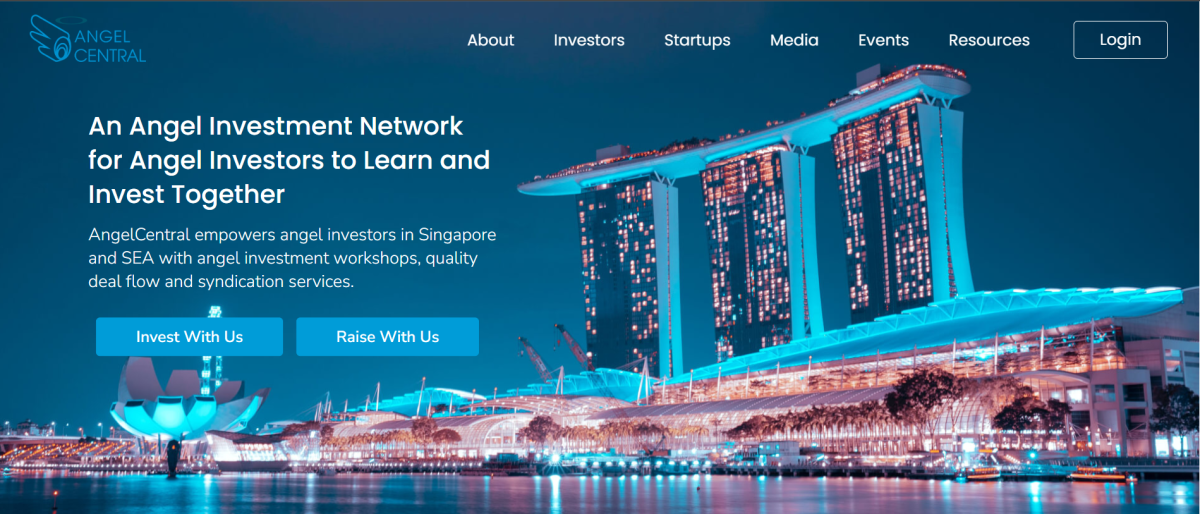
Singapore has an established angel investment ecosystem supported by networks, syndicates, and digital platforms that connect startups with early-stage investors.
The following platforms provide structured access to angel investors:
| Platform / network | Description | How founders can access | Geographic source |
| AngelCentral | Provides curated deal flow, investor education, and syndication opportunities for startups and investors | Join programmes, attend events, or participate in syndicates | Singapore & Southeast Asia |
| A2D Ventures | Enables co-investment into curated early-stage startups through digital syndicates | Apply to be featured and gain access to pooled investor capital | Southeast Asia |
| BANSEA (Business Angel Network Southeast Asia) | Connects early-stage startups with experienced investors through pitch sessions, mentorship, and investment opportunities | Apply to pitch at events or gain introductions through ecosystem partners | Southeast Asia |
| Singapore Angel Investment Network | Matches startups with angel investors through an online marketplace for fundraising and discovery | Create a startup profile and pitch directly to registered investors | Global (Singapore-focused) |
Venture capital firms in Singapore
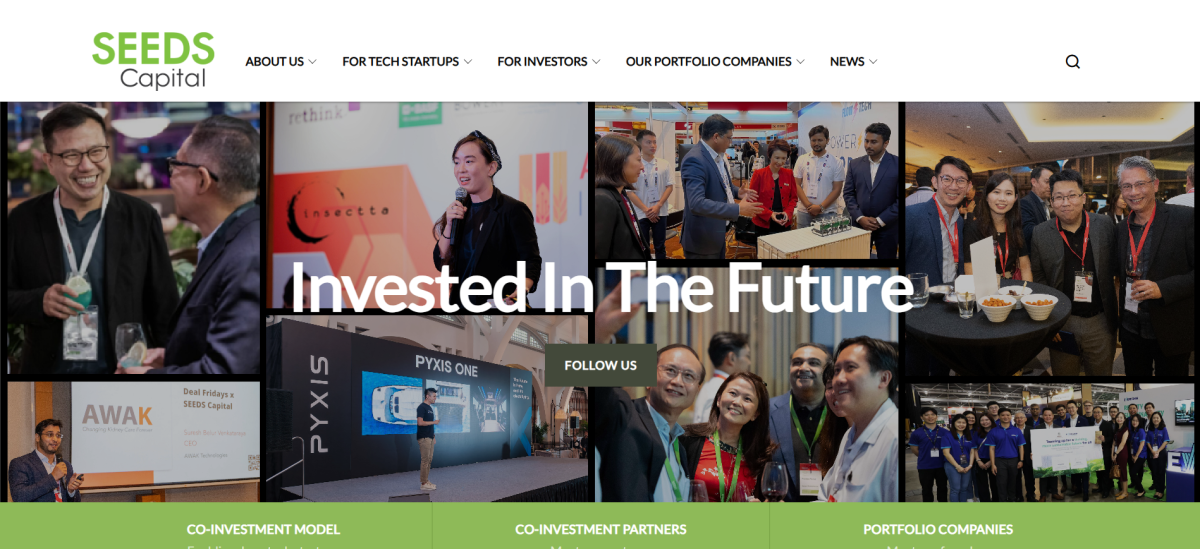
Singapore’s venture capital ecosystem includes both government-backed and private firms, each supporting startups at different stages of growth and innovation.
| Category | Firm | Type | Focus area | Role in startup ecosystem |
Government-backed | SEEDS Capital | Co-investment arm | Early-stage technology startups | Co-invests with VC firms to reduce investment risk and support startups with global potential |
| SGInnovate | Investment & ecosystem builder | Deep tech (AI, biotech, advanced engineering) | Supports talent development, research commercialisation, and connects startups with investors | |
Private VC | Golden Gate Ventures | Regional venture capital firm | Early-stage Southeast Asian startups | Invests in technology-driven businesses and supports regional expansion |
| Sequoia Capital | Global venture capital firm | High-growth technology companies | Provides large funding rounds and strategic guidance for scaling globally |
What is bootstrapping in Singapore

Bootstrapping refers to funding a startup using personal savings, personal income, or internally generated revenue. This approach allows founders to retain full ownership without taking on debt or giving up equity. In Singapore, bootstrapping is commonly used at the early stage to test business ideas and build a minimum viable product (MVP) before seeking external funding.
Runway expectations
- Founders must manage cash flow carefully, especially during the first 12–24 months.
- Personal savings should cover both business and living expenses during early development.
How to bootstrap effectively
- Keep fixed and operational costs low to extend runway
- Start lean and avoid unnecessary overhead
- Focus on building an MVP and validating demand early
- Reinvest any early revenue back into the business
Bootstrapping is typically used as a starting point before transitioning to grants, loans, or equity funding as the business grows.
Read more: 7 Tips To Grow Your Side Hustle Into a Business in Singapore
Key risks when funding your startup in Singapore
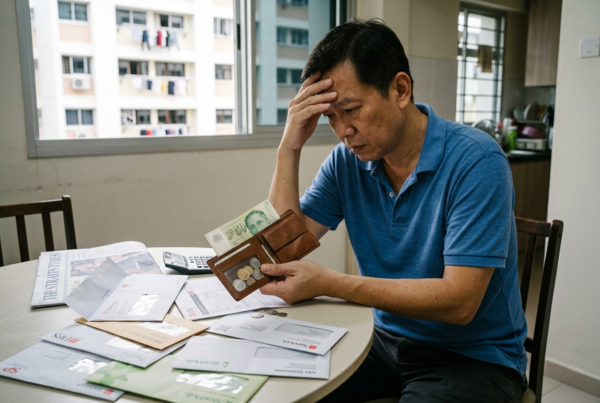
Funding supports startup growth, but it does not remove the underlying risks of building a business. Startup outcomes remain uncertain, with success depending on factors such as market demand, execution, and financial sustainability rather than funding alone.
1. Lack of market demand
A common reason startups fail is the absence of sufficient market demand. Businesses that do not address a clear customer need or fail to attract enough users may struggle to generate revenue, regardless of the amount of funding raised.
Validating demand early is essential before committing significant resources to growth.
2. Running out of cash
Startups frequently fail when they run out of cash before reaching key milestones. This typically happens when operating expenses exceed revenue over a sustained period or when funding is not managed effectively.
Maintaining control over spending and ensuring that available capital can support operations for a sufficient period is critical for survival.
3. Weak business models
An unclear or unsustainable business model can limit a startup’s ability to generate consistent revenue. Without a viable path to profitability, additional funding may not translate into long-term growth.
Startups must ensure that their business model supports both revenue generation and scalability.
4. Execution risk
Building and scaling a business involves execution challenges at every stage, including product development, market entry, and operational expansion. Even with sufficient funding, poor execution can prevent a startup from achieving its objectives.
Strong execution is necessary to convert funding into measurable progress.
5. High risk and uncertain outcomes
Startup outcomes are inherently uncertain, with a high likelihood of failure compared to established businesses. Returns are not guaranteed and depend on the company’s ability to grow, compete, and sustain its operations over time.
Funding improves access to resources but does not eliminate these risks.
Read more: What You Need To Know Before Starting a Freelance Career
How to choose the right funding option in Singapore

Choosing the right funding option depends on your business stage, funding needs, and how much control you want to retain. Different funding sources are designed for different purposes, so it is important to select one that supports your growth plans.
1. Consider your business stage and funding needs
Funding needs change as your startup grows. Early-stage businesses often rely on personal savings or grants such as Startup SG Founder. As the business develops, angel investors or venture capital can provide funding for expansion. More established startups may also use venture debt or financing schemes to support scaling.
2. Understand equity vs debt financing
Equity financing involves selling shares of the company to investors. It does not require repayment, making it suitable for high-risk or early-stage startups. However, it reduces ownership and may limit decision-making control over time.
Debt financing includes business loans and government-backed schemes such as the Enterprise Financing Scheme. It allows founders to retain full ownership but requires repayment with interest, which increases cash flow pressure.
The right choice depends on your ability to manage cash flow and your willingness to dilute ownership.
3. Align with relevant support schemes
Singapore offers targeted funding programmes. Startups focused on innovation can consider Startup SG Tech or Startup SG Equity, while SMEs improving operations or expanding can use PSG or EDG. Choosing the right scheme improves funding relevance.
4. Evaluate key factors before deciding
After identifying suitable funding types, founders should apply practical evaluation criteria to make informed decisions:
- Develop a clear business plan: Define financial projections and growth strategy to demonstrate viability.
- Check eligibility requirements: Ensure compliance with baseline criteria such as Singapore registration and minimum local ownership.
- Understand funding terms: Review repayment obligations, equity dilution, and investor expectations before committing.
- Balance funding levels: Secure sufficient capital to grow sustainably without creating unnecessary financial pressure or inefficient spending.
Selecting funding carefully helps ensure it supports long-term business stability.
Pros and cons of each funding options in Singapore
The following table summarises the key advantages and trade-offs of each funding type, helping founders compare options based on ownership, risk, and scalability.
| Funding type | Pros | Cons |
| Government grants | No repayment required and no equity dilution | Strict eligibility criteria and complex application process |
| Business loans | Full ownership retained and ability to build credit history | Requires repayment with interest and may require collateral or guarantees |
| Angel / Venture capital | Access to large capital and strategic mentorship | Equity dilution and reduced control over business decisions |
| Bootstrapping | Full control and independence | Personal financial risk and limited growth based on available capital |
Conclusion
Funding decisions shape more than just how a startup raises capital. They influence how quickly a business can move, the level of risk it carries, and the degree of control founders retain over time.
In Singapore’s funding landscape, the advantage lies in having multiple structured options rather than relying on a single path. Founders who take the time to evaluate trade-offs carefully are better positioned to make decisions that support both immediate needs and long-term direction.
A well-considered funding approach is not about choosing the most accessible option, but about selecting the one that aligns with how the business is meant to grow.
Read more: 10 Side Hustles That Can Supplement Your Income