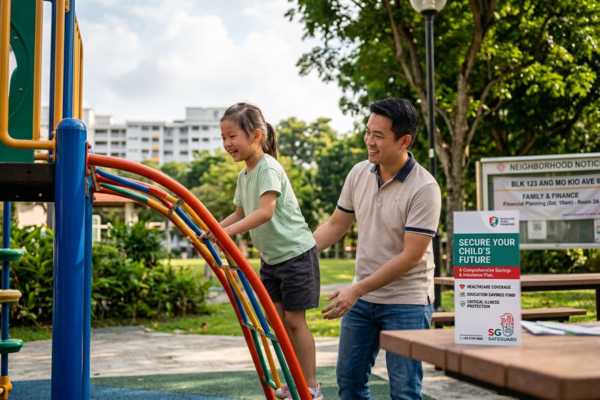
Raising a child in Singapore can be deeply rewarding, but it can also place pressure on the family budget. Beyond tuition fees, parents must plan for uniforms, textbooks, transport, co-curricular activities, digital devices, and post-secondary education costs.
The good news is that Singapore offers a wide range of education support schemes. These programmes ensure that every child, regardless of background, can access quality education.
This guide explains the key schemes, including Edusave, PSEA, MOE FAS, ISB, SCFA, and DigitalAccess@Home, to help parents understand what each covers, who qualifies, and how to use them effectively.
The challenge of school expenses
Public education in Singapore is heavily subsidised, but families still need to manage additional costs.
A primary school student may incur S$200 to S$300 a year for uniforms, books, and transport. Secondary school students often face higher expenses due to CCAs and enrichment programmes. Costs rise further at the post-secondary level, especially for tuition and daily living expenses.
Understanding available financial assistance schemes, and knowing when to use them, makes planning more manageable and affordable.
Key government and community support schemes
1. Edusave
Every Singapore Citizen aged 7-16 automatically receives an Edusave account from the Ministry of Education (MOE). The government credits annual contributions directly, S$230 for primary students and S$290 for secondary students.
Edusave funds earn interest and can pay for enrichment programmes, CCAs, and school-organised activities. Since 2024, Edusave also covers all miscellaneous school fees.
Students may also receive Edusave Awards, such as the Edusave Merit Bursary or Good Progress Award. MOE credits these awards directly into the Edusave account.
2. Post-Secondary Education Account (PSEA)
When a child turns 17, unused Edusave funds transfer automatically into the Post-Secondary Education Account (PSEA). The PSEA may also include unused Child Development Account (CDA) balances and government top-ups.
The PSEA earns 2.5% interest per annum, pegged to the CPF Ordinary Account rate. Families can use it to pay tuition fees at ITE, polytechnics, universities, approved private institutions, and overseas exchange programmes.
If funds remain unused, families may transfer them to a sibling’s PSEA or into the child’s CPF Ordinary Account after age 31.
Pro tip: Review approved institutions and uses on MOE’s PSEA website.
3. MOE Financial Assistance Scheme (FAS)
The MOE Financial Assistance Scheme (FAS) supports families with limited financial means. As of 2026, families qualify if they meet either of the following:
- Gross household income of S$4,000 or less.
- Per capita income (PCI) of S$1,000 or less.
Eligible students receive:
- Full waiver of school and miscellaneous fees.
- Free textbooks and uniforms.
- Meal subsidies and transport grants.
For qualifying families, FAS can cover nearly all compulsory school expenses.
Pro tip: Apply through your child’s school, usually between October and December each year.
4. Independent School Bursary (ISB)
Students attending independent schools, such as Raffles Institution or ACS (Independent), may qualify for the Independent School Bursary (ISB).
Families with a monthly household income of up to S$10,000, or a PCI of up to S$2,500, are eligible for full fee subsidies, as well as grants for textbooks, uniforms, and transport. Higher-income families may qualify for partial subsidies, and schools may provide additional internal support.
Pro tip: Check directly with the school’s bursary office for the latest details.
5. Student Care Fee Assistance (SCFA)
Many working parents rely on student care centres for after-school supervision. The Student Care Fee Assistance (SCFA) scheme, administered by the Ministry of Social and Family Development (MSF), helps reduce these costs.
To qualify, families must meet criteria such as:
- Child aged 7-14
- Parents working at least 56 hours per month
- Gross household income of S$4,500 or less or PCI of S$1,125 or less
Families may also receive a Start-Up Grant (SUG) to offset registration or deposit fees.
6. DigitalAccess@Home (IMDA)
Digital learning forms a core part of education today. The DigitalAccess@Home scheme by the Infocomm Media Development Authority (IMDA) supports families without adequate digital access.
Eligible households (with gross household income of S$1,900 or less or PCI of S$650 or less) can receive subsidised laptops or tablets and affordable home broadband.
7. Special Education Financial Assistance Scheme (SPED FAS)
Students enrolled in Special Education (SPED) schools receive additional support through SPED FAS. The scheme covers school fees, uniforms, textbooks, and transport. While eligibility follows MOE FAS guidelines, it offers greater flexibility for families with children who have special needs.
8. School-based opportunity funds and internal bursaries
Schools receive Opportunity Fund allocations from MOE to support students who may not qualify for national schemes but still face financial difficulties. Parents can approach schools for assistance with enrichment programmes, CCAs, or overseas trips.
Families may also seek help from Community Development Councils (CDCs), grassroots organisations, or charities such as the NTUC U Care Fund. These grants may support school supplies, groceries, or emergency needs.
Read more: A Parent’s Guide to Childcare Subsidies in Singapore
What these schemes can cover

When used together, education support schemes can help pay for:
- School and miscellaneous fees
- Textbooks, uniforms, and stationery
- Meals and transport
- Student care fees
- Enrichment programmes and CCAs
- Digital devices and broadband
- Post-secondary tuition and loans
Smart tips for managing education support funds
- Check balances early: Review Edusave and PSEA balances before making payments.
- Plan ahead: List upcoming school expenses and match them to available schemes.
- Apply on time: Many schemes open applications between October and December.
- Combine support: Use FAS for essentials and Edusave for enrichment.
- Ask schools for guidance: Teachers and counsellors can highlight additional funds.
- Stay updated: Budget announcements may include new top-ups or expanded support.
Read more: How To Teach Your Children Financial Literacy
Family scenarios

Single-child family
Edusave can cover enrichment classes, school trips, and CCAs. Working parents can apply for SCFA to reduce student care fees. Over time, tracking the PSEA balance helps prepare for post-secondary education.
Family with multiple children
Families can combine schemes across children. One child may qualify for MOE FAS, while another in an independent school benefits from ISB. DigitalAccess@Home can help ensure each child has access to a learning device.
Pro tip: Track each child’s eligibility and renewal dates to avoid missing out.
Teen entering post-secondary education
For students entering ITE, polytechnic, or university, the PSEA can pay tuition fees directly. Families may transfer unused PSEA funds between siblings or benefit from government top-ups announced during national Budgets.
Encouraging teens to understand their PSEA accounts also builds early financial awareness.
Read more: The Cost of Education in Singapore and How Parents Can Afford It
Why educational support matters
Education remains one of Singapore’s strongest pillars. These schemes ensure every child receives equal learning opportunities, regardless of household income. They ease financial stress for parents and allow children to focus on their studies with confidence.
By understanding how Edusave, FAS, ISB, and other schemes work together, families can plan ahead and make full use of the support available. With early preparation and timely applications, managing school expenses becomes far less overwhelming, allowing children to learn, grow, and pursue their goals without financial worry.