

Saving before having a baby means building sufficient financial reserves to cover pregnancy, delivery, childcare, baby-related expenses, insurance needs, and potential income disruption during the transition to parenthood.
For newlyweds researching baby expenses in Singapore, the main costs usually include pregnancy appointments, delivery bills, baby essentials, childcare, insurance, and housing commitments. There is no fixed amount every newlywed must save before having a baby. A realistic savings target depends on healthcare choices, income plans, childcare arrangements, housing commitments, and overall financial stability.
Key takeaways
- Being financially ready for a baby depends on your income, savings, insurance, housing, and childcare plans.
- Many newlyweds may find that saving around S$15,000 to S$30,000 helps cover baby expenses such as pregnancy and delivery costs, baby essentials, childcare deposits, medical expenses, insurance, and temporary income changes.
- Childcare is often the biggest long-term cost of having a baby in Singapore.
- Government support schemes can help reduce baby expenses in Singapore, but newlyweds still need savings because some benefits are paid out over time.
- Newlyweds who are planning for a baby financially should make sure they can comfortably manage expenses during the first 12–18 months after birth.
How much should you save before having a baby in Singapore?
The amount a newlywed should save before having a baby depends on delivery preferences, income plans, childcare arrangements, and existing financial stability. For newlyweds saving money, the goal is not to reach a universal number. The goal is to build a baby budget that matches the expected medical costs, childcare plans, income stability, housing commitments, and family support.
A couple choosing a subsidised public ward, maintaining two incomes, and using an anchor-operator childcare centre will generally require a smaller financial buffer than a couple choosing private healthcare, a temporary single-income arrangement, and private preschool education.
The table below shows how different choices can lead to very different savings needs when newlyweds are financially preparing for a baby.
| Factor | Couple A (lower cash outlay) | Couple B (higher cash outlay) | Why it affects savings needed |
| Delivery route | Subsidised public ward | Private hospital with chosen doctor | Out-of-pocket delivery costs differ materially by hospital type and ward class |
| Income after birth | Both parents continue working | One parent pauses work for one year | A 12-month income pause reduces household income substantially, requiring a larger cash buffer |
| Childcare | Anchor-operator centre with government subsidies | Private or international preschool | Monthly childcare costs after subsidies range from around S$300 a month at anchor-operator centres, where full-day fees are capped at S$610 before GST and before means-tested subsidies, to several thousand dollars at private or international preschools |
Financial readiness for parenthood depends on four related areas: cash flow supports recurring monthly expenses, insurance protects against major financial risks, housing stability keeps fixed costs predictable, and a child-related savings buffer covers upfront expenses and temporary income gaps.
Baby expenses Singapore newlyweds should prepare for before having a child

Having a baby creates both one-off and recurring expenses. Understanding the main cost categories helps newlyweds estimate a realistic savings target before pregnancy, birth, and early parenthood.
1. Pregnancy and delivery costs in Singapore
Pregnancy and delivery costs in Singapore are typically the largest single upfront cost of having a baby. The amount paid depends mainly on hospital type, ward class, delivery method, doctor choice, length of stay, and whether complications arise. A Caesarean delivery usually costs more than a vaginal birth because it is major surgery and may require a longer hospital stay.
The figures below are Ministry of Health median bills. A median bill is the typical bill where half of patients pay less and half pay more. These figures help newlyweds estimate a planning benchmark for pregnancy and delivery costs.
| Ward / setting | Normal delivery | Caesarean delivery |
| Public, Ward C (subsidised) | S$1,346 | S$3,004 |
| Public, Ward B2 (subsidised) | S$1,350 | S$2,582 |
| Public, Ward B1 (unsubsidised) | S$4,463 | S$8,490 |
| Public, Ward A (unsubsidised) | S$6,024 | S$9,839 |
| Private hospital (inpatient) | S$10,815 | S$15,805 |
These are median delivery bills, not fixed prices. Half of patients pay less than the figure shown, and half pay more. A newlywed’s own bill will change depending on length of stay, complications, delivery method, and the hospital’s final charges.
The public ward figures already reflect government subsidies for Singapore Citizens and Permanent Residents, so they are lower than unsubsidised costs. They include GST, but they come before any MediShield Life or MediSave payouts. This means the final out-of-pocket cost may be lower than the figure shown in the table.
Newlyweds can use these figures as a planning benchmark at two stages of pregnancy:
- When deciding between a public and private hospital and choosing a ward class that fits the household budget.
- When estimating how much to set aside in savings or how much insurance protection may be needed.
When newlyweds are ready to confirm their plans, they should treat these medians as a starting point rather than a quote. A hospital bill estimator or insurer can provide a figure that better reflects the chosen care route.
Read more: The Comprehensive Guide to Buying Maternity Insurance in Singapore
2. Infant and baby expenses in Singapore

Infant and baby expenses include upfront purchases before birth and recurring monthly costs after the baby arrives. These expenses affect the first few months of parenthood because many items must be purchased before or shortly after birth.
Common baby expenses include diapers, wipes, milk formula, feeding accessories, baby clothing, nursery equipment, medical appointments, and postnatal recovery products. Spending varies significantly depending on feeding choices, brand preferences, family support, and the use of second-hand equipment.
Typical upfront baby costs
| Item | Approximate cost range |
| Cot or bedside bassinet | S$200–S$800 |
| Stroller or travel system | S$300–S$2,000 |
| Car seat | S$200–S$800 |
| Baby carrier or wrap | S$80–S$400 |
| Bottles, steriliser, and feeding accessories | S$150–S$500 |
| Breast pump (personal purchase; some maternity packages include one) | S$100–S$500 |
| Baby clothing (newborn to six months) | S$200–S$500 |
| Diapers and wipes (first three months) | S$300–S$600 |
| Formula milk (if not breastfeeding, first three months) | S$300–S$900 |
| Postnatal recovery and baby healthcare items | S$200–S$500 |
| Approximate total | S$2,030–S$7,500 |
A practical baby setup budget often falls in the range of S$2,000 to S$7,500. This range reflects the combined cost of typical upfront purchases, including one-off equipment and consumables for the first three months.
Note: Estimated costs are based on typical retail prices from major Singapore baby retailers, including Mothercare Singapore, Pupsik Studio, FairPrice Singapore, and Shopee Singapore. Actual costs vary depending on brand, product specifications, and whether items are purchased new or second-hand.
Childcare and preschool costs in Singapore
Childcare and preschool costs are recurring expenses that often shape a family’s long-term baby budget after the baby arrives. In Singapore, the final monthly cost depends on preschool type, fee caps, government subsidies, and household income profile.
Singapore preschools fall into several broad categories, and the price gap between them can be large. Government fee caps help keep certain operators affordable, while private and international preschools usually set their own fees.
| Type of preschool | Examples | Rough monthly fee (full-day childcare, before subsidy) |
| Anchor Operator | PCF Sparkletots, My First Skool | ~$610 (capped) |
| Partner Operator | Star Learners, Little Skool-House | ~$650 (capped) |
| Private (non-scheme) | Independent neighbourhood centres | ~$1,200–$2,500 |
| International | Expat-focused, foreign curricula | ~$2,000–$3,500 or more |
Note: The Anchor Operator and Partner Operator fee caps apply to Singapore Citizen children for full-day childcare and take effect from 1 January 2026, down from S$640 (Anchor Operator) and S$680 (Partner Operator) in 2025. Figures exclude GST. These fee caps matter because they help Singapore Citizen children access lower-cost full-day childcare. Parents should still budget for GST, deposits, registration fees, and costs that subsidies do not fully cover.
Childcare subsidies for Singapore Citizen children
Childcare subsidies reduce the final amount paid by parents, but the out-of-pocket cost still depends on the preschool’s gross fees. Subsidies usually cover a larger share of fees at lower-cost anchor-operator centres than at private or international preschools.
Every Singapore Citizen child at an ECDA-licensed centre receives a Basic Subsidy. Lower- and middle-income families with a gross monthly household income of S$12,000 or below (or per capita income of S$3,000 or below) may also receive an Additional Subsidy. This income ceiling rises to S$15,000 from 2027. Parents do not usually apply separately for these subsidies. The preschool typically helps with the application, and the subsidy is paid directly to the centre.
For households with a working mother, Basic Subsidy and Additional Subsidy can reduce full-day infant care and childcare fees as follows:
| Programme | Basic Subsidy | Additional Subsidy (income-based) | Most you can get |
| Full-day infant care | Up to $600 per month | Up to $710 per month | Up to $1,310 per month |
| Full-day childcare | Up to $300 per month | Up to $467 per month | Up to $767 per month |
Because childcare can continue for several years, this decision often has a greater long-term financial impact than the delivery bill.
Read more: 2026 Updated Guide to Childcare Subsidies in Singapore
A practical savings framework for newlyweds in Singapore
A practical savings framework helps newlyweds assess whether they are ready for the financial changes that come with a baby. Newlyweds should assess cash flow, emergency savings, insurance, housing, and baby-specific costs together.
These areas are connected because recurring expenses, protection needs, fixed housing costs, and upfront parenthood costs all affect the total amount needed before having a child.
1. Emergency fund
An emergency fund is accessible cash set aside for unexpected expenses or income disruption. For new parents, this fund protects the household if medical bills, job changes, caregiving needs, or urgent baby-related costs arise.
As a general guide, newlyweds can keep at least six months of essential expenses in accessible cash. Households with variable income, self-employed income, or a single main earner may prefer nine to 12 months instead.
Newlyweds should keep the emergency fund separate from savings meant for baby-related costs. This separation keeps the household’s short-term safety buffer clear and easy to access when needed.
Pro-tip: You can use the Planner Bee emergency fund calculator to estimate an appropriate buffer before setting a separate savings target for parenthood.
2. Stable monthly cash flow
Stable monthly cash flow means the household can continue paying fixed expenses, debt repayments, savings commitments, and baby-related costs without relying on credit or emergency savings.
Newlyweds should review monthly income, fixed expenses, debt repayments, savings rate, childcare costs, and any expected income reduction during parental leave. This review helps determine whether future baby expenses can fit into the household’s regular budget.
A practical test is to save the expected childcare fee every month before the baby arrives. If this amount feels difficult to maintain, newlyweds may need to adjust spending, childcare plans, or income expectations.
3. Adequate insurance coverage
Insurance protects household finances against major medical, disability, and mortality risks. For new parents, adequate coverage matters because a child may become financially dependent on the household for many years.
Parents should review six core insurance categories that protect household income, medical affordability, and long-term family financial stability:
- Hospital coverage for both parents
- Life insurance
- Critical illness coverage
- Disability income protection
- Maternity-related coverage, where applicable
- Newborn hospital coverage
The goal is to ensure the family can remain financially stable if illness, disability, or death affects either parent.
Read more: What Insurance Should You Get for Your Child in Singapore?
4. Housing stability
A stable housing plan helps parents anticipate fixed costs while preparing for the practical needs of a growing household. Housing readiness for new parents should include factors that affect affordability, caregiving support, and suitability for a growing household:
- Suitability of the current home for a growing family
- Pending BTO completion or renovation plans
- Rent or mortgage affordability
- Proximity to family support networks
Home ownership is not required before starting a family, but newlyweds should have a housing plan that remains affordable and suitable as their household grows.
5. Child-related savings buffer
A child-related savings buffer should provide cash for expected expenses before, during, and shortly after birth, including:
- Pregnancy and delivery expenses
- Baby equipment and setup costs
- Confinement or postnatal care
- Infant care deposits
- Early medical expenses
- New insurance premiums
- Temporary income reductions
- Timing gaps before government payouts arrive
A dedicated savings buffer helps cover pregnancy and delivery expenses, baby equipment, childcare deposits, insurance premiums, and temporary income reductions during early parenthood. This fund is separate from the emergency fund because baby expenses are expected, while emergency savings are reserved for unexpected events.
Government schemes that reduce baby expenses in Singapore
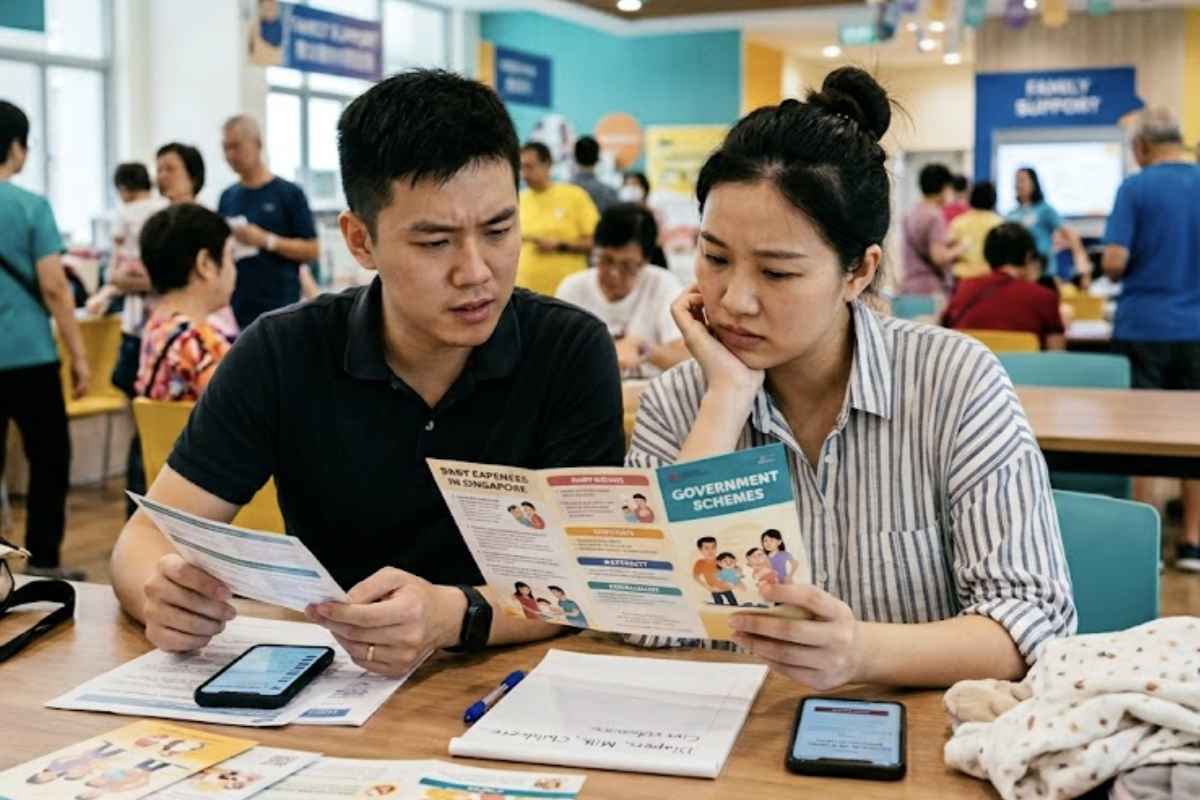
Several Singapore government schemes can help offset pregnancy, childcare, healthcare, and child-raising expenses. Understanding these programmes can help newlyweds estimate how much support may be available as they plan for parenthood.
Government support can reduce baby expenses in Singapore, but it does not remove the need for upfront savings. Some benefits come as staged cash payouts, tax reliefs, MediSave withdrawals, Child Development Account grants, or matching contributions rather than immediate cash available before expenses arise.
| Scheme | Key benefit |
| Baby Bonus Cash Gift | Cash payouts are provided during a child’s early years. |
| Child Development Account (CDA) | Government grants and matching contributions for approved child-related expenses, such as preschool fees and healthcare costs. |
| MediSave Maternity Package | Allows eligible MediSave withdrawals for pregnancy, delivery, and hospitalisation expenses. |
| Parenthood Tax Rebate (PTR) | Reduces income tax payable for eligible parents. |
| Working Mother’s Child Relief (WMCR) | Provides tax relief for eligible working mothers. |
| Large Families Scheme | Additional support for eligible families with three or more children. |
Read more: Benefits of Child Development Account and Child Savings Account
Recommended savings targets for newlyweds before starting a family
Recommended savings targets provide a practical benchmark for newlyweds planning for a baby financially in Singapore. The right amount depends on each household’s income, healthcare choices, childcare plans, family support, and risk tolerance.
The following framework can help newlyweds assess financial readiness before having a child.
| Readiness area | What to aim for |
| Emergency fund | Six to 12 months of essential expenses |
| Baby-specific savings | A one-off fund for pregnancy, delivery, and essential baby items. Budget according to your chosen care route, as public and private delivery costs can vary significantly |
| Childcare buffer | Three to six months of expected childcare fees |
| Insurance | Reviewed before or early in pregnancy |
| Monthly cash flow | Remains positive after baby-related expenses |
| Housing | Stable and predictable |
This framework provides a practical benchmark rather than a mandatory requirement. Households with different lifestyles, income levels, and childcare arrangements may require more or less savings.
Conclusion
Newlyweds do not need to be wealthy before starting a family, but they should be financially prepared for future baby expenses. Financially preparing for a baby means building an emergency fund, maintaining stable cash flow, reviewing insurance coverage, planning for childcare, and setting aside dedicated baby-related savings.
The most appropriate savings target is one that aligns with the household’s expected expenses, income plans, childcare choices, healthcare preferences, and long-term family goals.
Frequently asked questions
Is there a minimum amount we must save before having a baby in Singapore?
No. There is no official minimum savings requirement. Newlyweds should determine an appropriate amount based on their expected expenses, childcare plans, and overall financial commitments.
Is S$10,000 enough before having a baby in Singapore?
S$10,000 may be sufficient for some households, particularly those using subsidised healthcare and lower-cost childcare arrangements, though most newlyweds will find a target closer to the S$15,000 to S$30,000 range more comfortable once delivery, baby setup, and a temporary income buffer are included. The amount required varies according to planned expenses, income circumstances, childcare choices, and lifestyle preferences.
Can a subsidised delivery cost almost nothing out-of-pocket?
Subsidies and MediSave can substantially reduce delivery costs for eligible Singaporean couples. Actual expenses vary according to hospital, ward class, delivery type, length of stay, and any medical complications.
What factors have the biggest impact on the cost of having a baby in Singapore?
Childcare arrangements, delivery choices, and income changes after the birth of a child generally have the greatest impact on the cost of having a baby in Singapore. Childcare can have the largest long-term effect because parents may pay preschool fees for several years.
Should we save for childcare before the baby is born?
Yes. Households planning for both parents to return to work should incorporate childcare costs into their financial planning before the baby arrives. Maintaining a childcare buffer of three to six months of expected fees can provide additional flexibility.
Should we review insurance before or after the baby arrives?
Parents should review insurance coverage before the baby arrives. Hospitalisation, life insurance, critical illness coverage, disability protection, and newborn hospital coverage needs often increase once a child becomes financially dependent on the household.