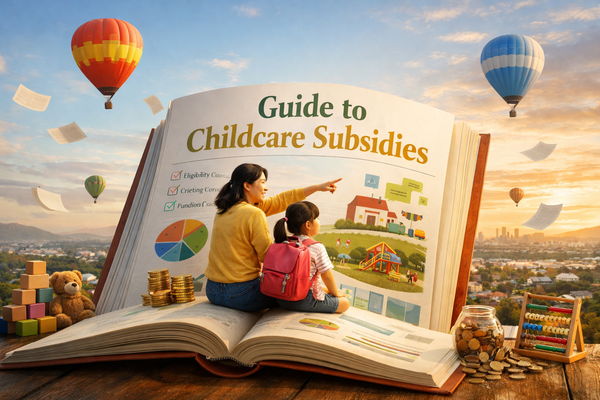

Childcare costs in Singapore can be significant; however, government subsidies help make infant care, childcare, and kindergarten more affordable for families. Furthermore, these subsidies vary based on income level, employment status, and the type of preschool programme, so understanding how they work enables parents to reduce out-of-pocket expenses effectively.
Key takeaways
- Singapore provides structured childcare subsidies to reduce preschool and infant care costs for families.
- Basic Subsidy offers up to S$600 for working mothers with children in infant care.
- Additional Subsidy is means-tested and depends on household or per capita income.
- Low-income families can access further assistance through CCFA and Start-Up Grants.
- Budget 2026 enhancements will increase income ceilings, expanding eligibility from 2027.
What are childcare subsidies in Singapore?
Childcare subsidies in Singapore are government-funded financial support schemes designed to reduce the cost of infant care, childcare, and kindergarten for eligible families. These subsidies are administered through agencies such as the Early Childhood Development Agency (ECDA) and the Ministry of Social and Family Development (MSF).
They primarily target preschool-related expenses and vary based on income level, employment status, and the type of childcare programme.
How the Baby Bonus Scheme complements childcare subsidies
The government offers the Baby Bonus Scheme as a broader initiative that complements childcare subsidies by providing cash gifts and Child Development Account (CDA) co-matching. While it is not a childcare subsidy, parents can use the funds to offset preschool-related expenses such as childcare fees and medical costs.
| Child order | Total amount | Baby Bonus Cash Gift | CDA First Step Grant | Government Co-matching Cap |
| First child | S$20,000 | S$11,000 | S$5,000 | S$4,000 |
| Second child | S$23,000 | S$11,000 | S$5,000 | S$7,000 |
| Third and fourth child | S$32,000 | S$13,000 | S$10,000* | S$9,000 |
| Fifth and subsequent | S$38,000 | S$13,000 | S$10,000* | S$15,000 |
Note: *Third and subsequent Singapore citizen children born from 18 February 2025 receive an increased CDA First Step Grant of S$10,000 (up from S$5,000) under the Large Families Scheme.
Read more: Benefits of Child Development Account and Child Savings Account
Subsidies for infant care, childcare, and kindergarten

Singapore’s childcare subsidy framework consists of five primary schemes designed to reduce preschool and childcare costs:
- Basic Subsidy
- Additional Subsidy
- Child Care Financial Assistance (CCFA) and Start-Up Grant
- Kindergarten Fee Assistance Scheme (KiFAS)
- KiFAS Start-Up Grant
These subsidies collectively target different income levels and childcare stages, from infant care to kindergarten.
Basic Subsidy
The Basic Subsidy is a universal childcare subsidy available to Singapore Citizen children enrolled in ECDA-licensed childcare centres.
Eligibility does not depend on household income. Instead, the subsidy amount varies based on the mother’s employment status:
- Working mothers receive up to S$600 for full-day infant care (aged 2 – 18 months) or S$300 for childcare (aged 18 months – 6 years).
- Non-working mothers receive up to S$150.
In cases involving divorce, separation, or widowhood, a working single father may apply as the main applicant.
Additional Childcare Subsidy
The Additional Subsidy provides further financial support on top of the Basic Subsidy and is means-tested based on income.
To qualify, families must meet one of the following criteria:
- Gross monthly household income (HHI) of S$12,000 or below
- Per capita income (PCI) of S$3,000 or below for larger households
Eligibility also requires the main applicant (typically the mother) to be working at least 56 hours per month.
The subsidy amount depends on:
- Employment status of the applicant
- Household income level
- Type of childcare programme (infant care or childcare)
- Programme duration (full-day, half-day, flexi-care)
- Centre fees
The breakdown of childcare and infant care subsidies is as follows:
This table outlines the basic and additional childcare subsidies available to working and non-working applicants based on household and per capita income, along with the minimum co-payment required. Subsidy amounts decrease and co-payments increase as income levels rise.
| Full-day childcare subsidies (New rates from 1 Jan 2026) | |||||
| Applicant’s working status | Gross monthly household income | Gross monthly per capita income | Basic Subsidy (BS) | Max Additional Subsidy (AS) | Min co-pay |
Working applicant | S$3,000 and below | S$750 and below | S$300 | S$467 | S$3 |
| S$3,001 — S$4,500 | S$751 — S$1,125 | S$440 | S$25 | ||
| S$4,501 — S$6,000 | S$1,126 — S$1,500 | S$340 | S$58 | ||
| S$6,001 — S$7,500 | S$1,501 — S$1,875 | S$260 | S$104 | ||
| S$7,501 — S$9,000 | S$1,876 — S$2,250 | S$190 | S$162 | ||
| S$9,001 — S$10,500 | S$2,251 — S$2,625 | S$130 | S$232 | ||
| S$10,501 — S$12,000 | S$2,626 — S$3,000 | S$80 | S$315 | ||
| Above S$12,000 | Above S$3,000 | N/A | |||
| Non-working applicant | S$150 | N/A | |||
This table shows the subsidy structure for infant care, with higher base and additional subsidies compared to childcare, reflecting the higher cost of infant care. Similar to childcare, eligibility and co-payments vary according to income tiers, with greater support for lower-income households.
| Full-day infant care subsidies* | |||||
| Applicant’s working status | Gross monthly household income | Gross monthly per capita income | Basic Subsidy (BS) | Max Additional Subsidy (AS) | Min co-pay |
Working applicant | S$3,000 and below | S$750 and below | S$600 | S$710 | S$40 |
| S$3,001 — S$4,500 | S$751 — S$1,125 | S$640 | S$110 | ||
| S$4,501 — S$6,000 | S$1,126 — S$1,500 | S$500 | S$250 | ||
| S$6,001 — S$7,500 | S$1,501 — S$1,875 | S$380 | S$360 | ||
| S$7,501 — S$9,000 | S$1,876 — S$2,250 | S$240 | S$500 | ||
| S$9,001 — S$10,500 | S$2,251 — S$2,625 | S$100 | S$640 | ||
| S$10,501 — S$12,000 | S$2,626 — S$3,000 | S$40 | S$700 | ||
| Above S$12,000 | Above S$3,000 | N/A | |||
| Non-working applicant | S$150 | N/A | |||
Note: *There have been no changes to subsidies for infant care since 1 Jan 2023.
Childcare subsidies were adjusted for 2026, while infant care subsidies remain unchanged since 2023. The reduction in minimum co-payment compared to 2025 improves affordability for families.
Child Care Financial Assistance and Start-Up Grant
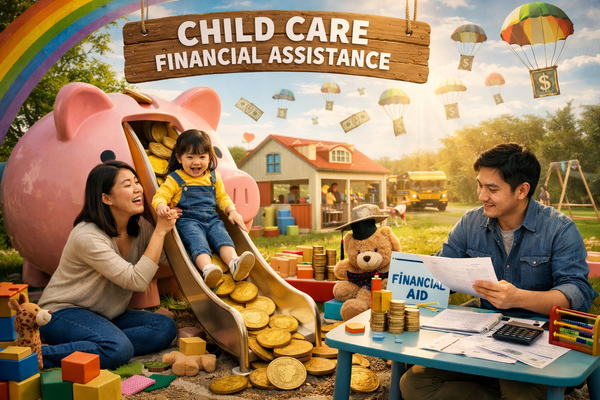
The Child Care Financial Assistance (CCFA) scheme provides additional support for low-income families who still face difficulty paying fees after receiving Basic and Additional Subsidies.
Approved assistance is disbursed directly to childcare centres, reducing the amount parents need to pay out-of-pocket.
The Start-Up Grant (SUG) complements CCFA by covering initial enrolment costs. It is capped at S$1,000 per child and includes:
- Registration fees
- Deposits
- Uniforms
- Insurance
- Bedding items
Eligibility requires:
- The child to be a Singapore Citizen
- Enrolment in an affordable childcare centre
- Parents working at least 56 hours per month or having valid reasons for not working
Families can apply through their childcare centre. Each child is eligible for the grant once, with appeals subject to MSF approval.
Kindergarten Fee Assistance Scheme (KiFAS)
The Kindergarten Fee Assistance Scheme (KiFAS) ensures that kindergarten education remains accessible to children from lower- to middle-income households.
Subsidies range from S$19 to S$163 per month and are disbursed directly to the kindergarten.
Eligibility criteria include:
- Singapore Citizen child
- Enrolment in an Anchor Operator or MOE Kindergarten
- Household income of up to S$12,000 or PCI of up to S$3,000
Special Approval allows non-parent caregivers, such as grandparents or foster parents, to apply for enhanced support. Families under ComCare or public rental housing automatically qualify for maximum subsidies.
Subsidies are paid directly to the kindergarten, and parents only pay the remaining fees using cash or CDA funds.
KiFAS Start Up Grant (SUG)
The KiFAS Start-Up Grant provides annual financial support for kindergarten enrolment costs.
The grant covers:
- Registration fees
- Deposits
- Uniforms
- Insurance
- Educational materials
The grant is capped at S$240 and is targeted at lower-income families with:
- Monthly household income of up to S$1,900, or
- PCI of up to S$650
Applications are assessed on a case-by-case basis and submitted through the child’s kindergarten.
Budget 2026 updates and future changes

Budget 2026 introduced enhancements to childcare subsidy schemes aimed at improving affordability.
From January 2027:
- The household income ceiling will increase from S$12,000 to S$15,000
- PCI ceiling will rise from S$3,000 to S$3,400
More than 60,000 families with children enrolled in preschools will benefit from these enhancements, indicating a significant expansion in subsidy accessibility.
These updates align subsidy thresholds with rising household incomes and ensure continued support for lower- and middle-income families.
Conclusion
Childcare-related expenses in Singapore include delivery costs, infant care, childcare, and daily essentials, and government subsidies significantly reduce these financial pressures.
By maximising all available childcare subsidies, families can fully utilise the support available to them and improve affordability across every stage of early childhood development.
When planning for a newborn or evaluating childcare options, parents should assess all available subsidies alongside their financial planning considerations to optimise long-term cost management.
Read more: The Cost of Education in Singapore and How Parents Can Afford It